The Conversations Continue: From Research to Impact
What does it mean for education research to make a real difference in schools? That question sat […]
Read More
How can pedagogy and AI work together to help students become more aware of their thinking and take greater ownership of their learning? In their presentation at the Redesigning Pedagogy International Conference 2026, two teachers from Pasir Ris Primary School share their experiences in designing a Primary 5 Science learning experience that combines explicit modelling of thinking with Snorkl AI, an AI-powered formative assessment platform, to make students’ thinking visible as well as deepen their capacity for reflection.
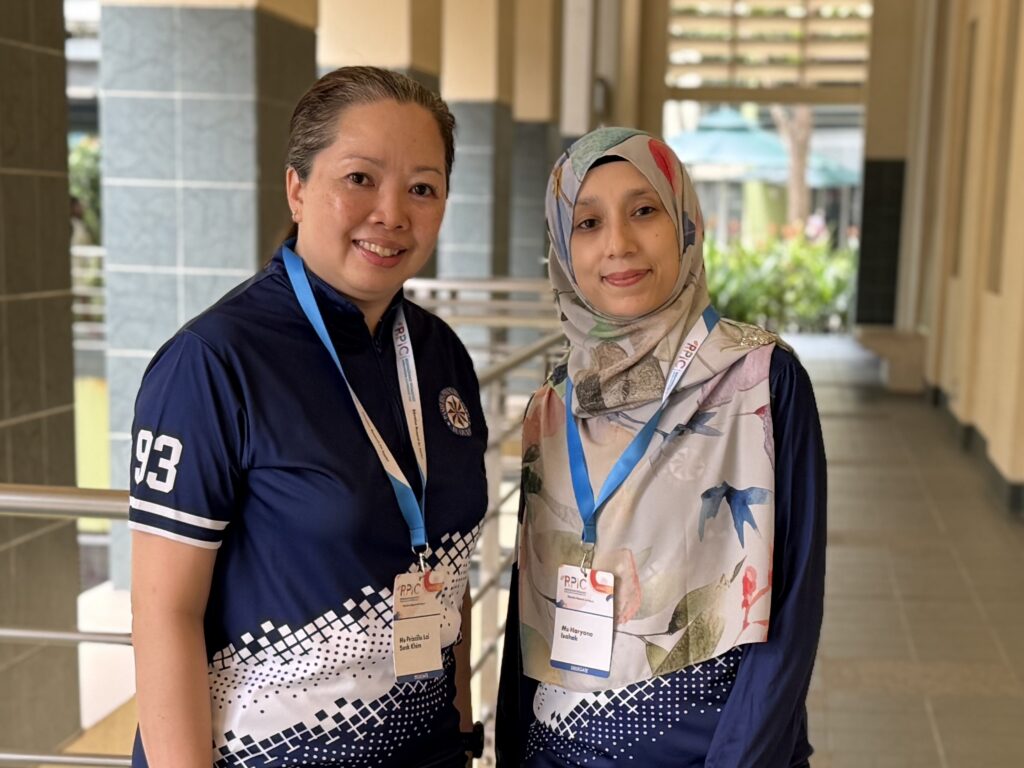
From left: Mrs Priscilla See and Mdm Haryana Bte Mohd Isahak, Pasir Ris Primary School.
As science teachers, Mdm Haryana Bte Mohd Isahak, Head of Department for Science, and Mrs Priscilla See, Senior Teacher for Science, have observed a recurring challenge in their classrooms: while many students can provide the correct answers, they often struggle to explain the reasoning behind them.
“Students are generally able to arrive at the correct answer, but many find it difficult to articulate how they got there,” Haryana shares. “Their explanations are often brief and lack scientific justification.”
To bridge this gap, Priscilla, Haryana and a team of teachers from Pasir Ris Primary School set about rethinking how learning can better support students in making their thinking visible. They adopt a think-aloud pedagogy, where teachers explicitly model the reasoning behind scientific concepts by verbalizing their thought processes. Students then practise making their own thinking explicit through structured peer discussions and recorded verbal responses.
This was put into practice in a Primary 5 Science lesson on water purification and the water cycle. By the time students engage with the core task, they have already been introduced to key concepts such as evaporation and condensation – giving the lesson space to focus on deepening reasoning.
“Our inquiry question is not simply what students are learning, but how we can help them become more aware of their thinking,” Haryana explains. “We want students to not only acquire scientific knowledge, but also to develop competencies such as critical and inventive thinking, communication and collaboration.”
“Rather than treating feedback as a one-off event, students are encouraged to revise and resubmit their explanations after reflecting on the AI-generated feedback.”
– Haryana, on Snorkl AI and student feedback
To complement their think-aloud process, students use Snorkl AI to record explanations of their scientific reasoning. The platform analyses their responses and provide immediate feedback on strengths and areas for improvement.
“Rather than treating feedback as a one-off event, students are encouraged to revise and resubmit their explanations after reflecting on the AI-generated feedback,” Haryana says. “They are expected to refine their thinking and improve the quality of their explanations.”
This iterative cycle of feedback, reflection and revision creates a learning environment where students can monitor their own progress and identify gaps in their understanding. The teachers observe that this process motivates students across a range of abilities.
“It is heartening to see students putting in effort to improve their responses,” she shares. “Even our lower-progress students are more motivated to refine their explanations and challenge themselves.”
Over time, students begin to view mistakes not as indicators of ability, but as opportunities for learning – a shift the teachers see as central to building a growth mindset. Flexibility in how students communicate their thinking also plays an important role. As part of the self-directed learning experience, students work in self-selected groups and exercise choice in how they demonstrate their understanding, whether through recorded verbal explanations, drawings or written responses.
“Some students prefer to speak their thinking aloud, while others find it easier to draw or write,” Priscilla notes. “Giving them that choice means they can participate meaningfully, regardless of their strengths or communication preferences.”
Beyond supporting students, the platform offers teachers a richer window into student thinking. One feature the team finds particularly valuable is the automatic transcription of students’ verbal responses, which captures evidence of reasoning that written work alone often cannot reveal.
“The transcripts allow us to identify misconceptions, analyse students’ reasoning processes and determine where additional support might be needed,” Priscilla remarks.
A common example is students conflating water vapour and water droplets – a misconception that transcripts surface quickly, allowing teachers to intervene and adjust their instruction before misunderstanding takes hold.
The platform also generates class-level analytics that highlight common strengths and learning gaps, giving teachers an overview of student understanding without requiring them to review every response individually.
“The real-time insights allow us to identify patterns in student thinking and respond more quickly to students’ learning needs,” Priscilla notes. “This data-informed approach enables more responsive teaching while reducing the time needed to gather formative assessment evidence.”
“The real-time insights allow us to identify patterns in student thinking and respond more quickly to students’ learning needs”
– Priscilla, on how analytics can help teachers
While the AI platform has brought clear benefits, both teachers are emphatic that technology should complement rather than replace teacher judgement. They note that there have been instances where the AI misreads a student’s intended meaning or uses language that does not fully align with curriculum expectations – moments that underscore the irreplaceable role of the teacher in validating, clarifying and contextualizing feedback.
“AI can support learning, but teachers still need to exercise professional judgement,” Haryana notes. “We cannot simply take the feedback at face value.”
For Haryana and Priscilla, this points to a broader principle: effective innovation begins with sound pedagogy. The value of AI, in their view, lies not in automating teaching but in creating more opportunities for students to reflect, refine their thinking and take an active role in their own learning.
“What encourages us most is seeing students identify their own gaps, discuss ideas with peers and take responsibility for improving their work,” Haryana remarks.
“As schools continue to explore emerging technologies, our experience shows how thoughtful integration of pedagogy and AI can make learning more visible, feedback more actionable and students more empowered as learners,” she adds.