The Conversations Continue: From Research to Impact
What does it mean for education research to make a real difference in schools? That question sat […]
Read More
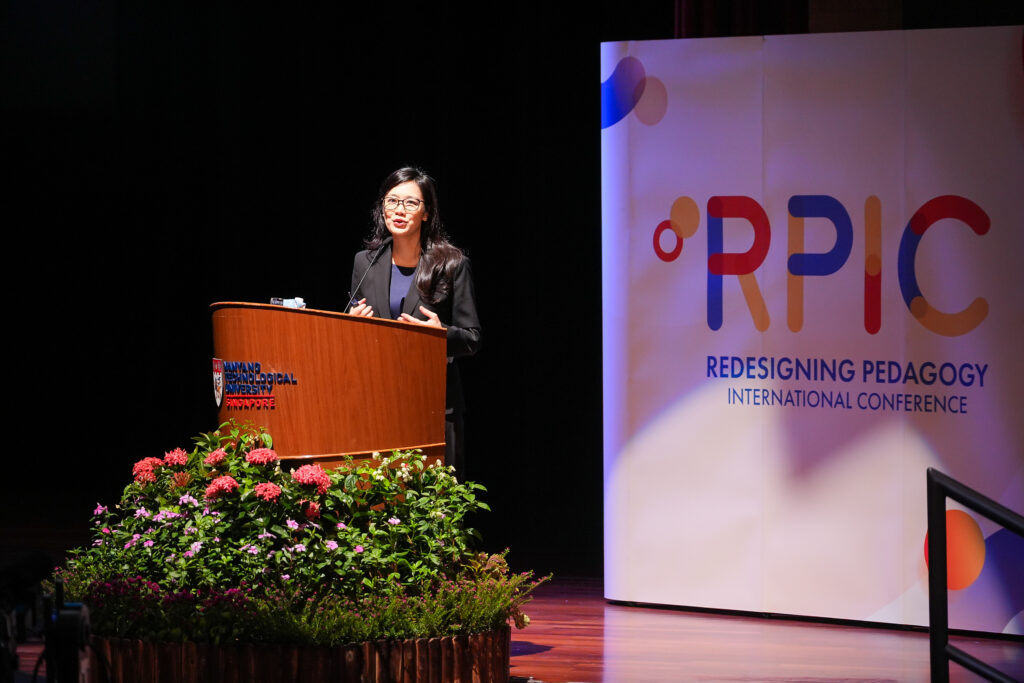
Singapore is often held up as a global success story in education. Yet behind this achievement lies a sobering reality: approximately one in three young people report severe levels of depression, anxiety or stress. This tension between excellence and distress is the central paradox explored by Setoh Peipei, Professor of Psychology at Nanyang Technological University, in her keynote address, “What Would It Take for Every Child to Succeed?”, at the Redesigning Pedagogy International Conference (RPIC) 2026. Drawing on findings from the Growing Up in Singapore Towards Healthy Outcomes cohort study, she highlights four strengths – motivation, autonomy, relationships and critical thinking – that can help shift children’s trajectories from merely surviving to truly discovering and thriving.
In her recent book, Unease: Life in Singapore Families, Associate Professor Teo You Yenn argues that parental stress in Singapore is not merely a personal issue, but one that is also shaped by broader structural forces. She notes how parents feel that the education system will determine their children’s futures and everyone is stuck, collectively, playing the same game (Teo, 2026).
With standardized tests and examinations carrying significant consequences for students’ futures, they have increasingly come to be seen as defining moments rather than checkpoints in the learning journey.
“Policy has sought to address this by having education reforms, shifting from a survival-driven phase in the 60s and 70s, to efficiency-driven in the 80s and 90s, and ability-based and values-driven in the 2000s and 2010s, respectively. Since 2020, it has shifted towards a ‘learning for life’ ethos,” Professor Setoh Peipei, who has joint appointments at National Institute of Education, and A*STAR’s Institute for Human Development and Potential, shares.
Even so, she posits that policy change alone is insufficient. Between policy and child outcomes lie many mediating layers, such as cultural beliefs, family functioning and everyday parent-child interactions, to name a few. It is within these layers that meaning is made or lost.
To understand these layers, Professor Setoh draws on the Growing Up in Singapore Towards Healthy Outcomes (GUSTO) cohort study, a long-term study following Singaporean children from birth through adolescence. In a recent phase, more than 500 parent-teen pairs were video-recorded in the Parent and Adolescent Interaction and Reflection (PAIR) task, a 10-minute conversation about real-life disagreements. These exchanges illuminated four strengths that can make a meaningful difference for children’s success and wellbeing.
“Children are not unmotivated – they can spend hours immersed in video games, sports or books,” Professor Setoh notes. “The question, is not whether they can focus, but what they choose to focus on, and why.”
Drawing on Deci and Ryan’s Self-Determination Theory, she distinguishes three kinds of motivation: intrinsic (I learn because I enjoy it), identified (I learn because it matters to my goals) and external (I learn to earn rewards or avoid punishment).
“Helping children find personal meaning in learning is thus a more powerful driver than rewards or consequences.“
– Professor Setoh, on intrinsic motivation
“Using data from 641 GUSTO participants surveyed at age 11.5 and tracked through their PSLE, the research team found that intrinsic motivation and identified regulation significantly predicted better PSLE outcomes, even after accounting for background factors,” she shares. “However, external pressure showed no significant association with achievement.”
“Helping children find personal meaning in learning is thus a more powerful driver than rewards or consequences,” she adds.
However, findings from the PAIR conversations reveal that the tension between the two approaches – nurturing intrinsic meaning versus fuelling externally motivated anxiety – runs through many Singapore families.
Professor Setoh shares a humorous cartoon that contrasts two moments in the same person’s life. As a child, she is chastised for “staring into space” during class. Decades later, she is celebrated as an astronomer, receiving an award for spending her career studying space. The irony underscores Professor Setoh’s point: behaviours that appear problematic in one setting may, under different circumstances, reveal a child’s emerging interests and strengths.
“What looks like a flaw in one context can be the seed of a passion in another. An educator’s job therefore is to see potential in children rather than problems,” she emphasizes.
This calls for supportive, autonomy-granting environments. The GUSTO study identifies three profiles at age four and a half: over half of mothers were supportive (warm, autonomy-granting, low in harshness), 35% were supportive-harsh and 13% were unsupportive.
“By ages nine and ten, children of unsupportive mothers are more likely to perceive indifference and report depressive symptoms. The study shows that warmth, calm regulation and respect for children’s preferences consistently predicted better emotional outcomes over time,” she notes.
The GUSTO study finds that parent-child communication functions as a “modifiable mediator” – a changeable factor that drives outcomes.
“In families with higher levels of dysfunction, we see less trust, poorer communication and greater feelings of alienation between the parents and the children, which correlate with an increase in depressive symptoms,” Professor Setoh says.
On the other hand, strong communication predicts greater resilience and fewer depressive symptoms. Supportive peer experiences similarly build resilience, while bullying increases risk. These patterns held even after controlling for socioeconomic background and earlier mental health.
“This is important because while we may not be able to easily change things like socioeconomic status or past stressors, we can change mediators,” she points out. “It is the positive, open and responsive parent-child communication that acts as a protective pathway for both well–being and mental health.”
In one PAIR conversation, a mother offers to tutor her son in Math. In response, he jokes that he would rather learn from ChatGPT. They laugh. However, this exchange points to larger forces at play, namely, the ecosystem we are in and how it shapes our beliefs about artificial intelligence (AI).
“In a survival-driven system, AI becomes a tool for getting the right answer quickly. On the other hand, in a learning-for-life approach, AI should serve as a scaffold for thinking, and not as a replacement for it,” Professor Setoh emphasizes.
She describes the risk of cognitive foreclosure, in which children outsource thinking to AI before the underlying skills are fully developed, leading to fundamental abilities (such as cognitive effort, reasoning and judgement) never being properly built.
“I advocate for a simple principle: think first, AI second. This means that AI should extend thinking, and not be a replacement for it,” she recommends.
Longitudinal studies in Singapore, such as GUSTO, Singapore Kindergarten Impact Study (SKIP) and DREAMS: DRivers, Enablers, and pathways of Adolescent developMent in Singapore, amongst others, hold pre-AI baseline data on cognition and literacy. She notes how these studies offer a rare opportunity to track how these skills evolve as AI becomes more embedded in daily life.
“I advocate for a simple principle: think first, AI second. This means that AI should extend thinking, and not be a replacement for it.”
– Professor Setoh, on ensuring AI supports thinking
Returning to the question she opens with: “What will it take for every child to succeed?”, Professor Setoh’s answer is that we must first redefine success itself. When it is defined narrowly, the result is comparison, fear and a persistent anxiety about falling behind.
“However, when conditions shift and when children find meaning in learning, when their autonomy and strengths are recognized, and when their relationships are trusting and open, the youth will engage, persist and grow,” she notes.
Calling upon David Yeager’s concept of inclusive excellence, when high standards are paired with high support, young people across all backgrounds can reach further, achieve more and build a stronger society together.
“This should also be reflected in the language we use with each other,” she says. “Instead of ‘There is only room for so many’, we might say, ‘Let’s find ways to expand the opportunity’. Instead of ‘Your success is a threat to mine,’ we might say, ‘Your success gives me a map’.”
She emphasizes that if we want every child to succeed, we must be able to redefine success itself, to expand opportunities, to see potential in our children, to build strong relationships with them and to take the long view.
She ends the keynote on the optimistic note, “This is what it will take and it is within our reach.”
References
Teo, Y. Y. (2026). Unease: Life in Singapore families. Ethos Books. https://www.ethosbooks.com.sg/products/unease-life-in-singapore-families