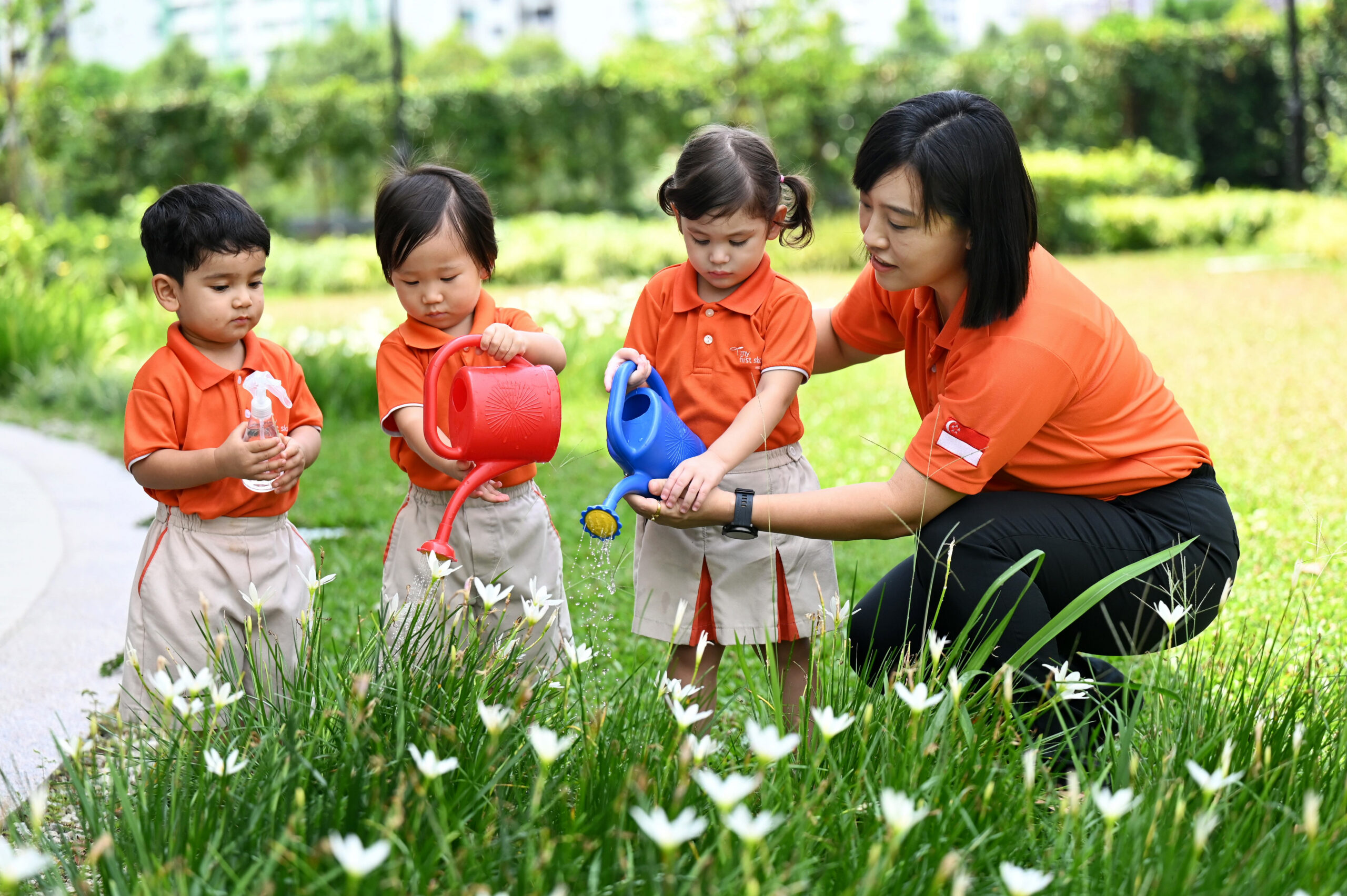
Young Children’s Voices in Mathematical Problem Solving
Contributed by Dr Ho Siew Yin and Sng Wei Qin Abbie, from NTUC First Campus, for SingTeach Virtual […]
Read More
Five years ago, I guest edited a SingTeach issue on Knowledge Building (KB) during NIE’s 70th anniversary. I’m honoured to do so again as we mark our 75th year. KB took root in Singapore two decades ago. As a Science teacher in the early 2000s (MOE Masterplan 1), I saw how KB resonated with my students – and I’ve not looked back since. Supported by many, KB has grown through shared spaces and opportunities. This issue marks another milestone as we trace our roots, honour the KB community and look ahead.
What is KB? Knowledge Building (KB) mirrors the work of innovative teams, turning classrooms into communities where learning is driven by the collective advancement of ideas. Guided by principles like epistemic agency and collective cognitive responsibility, KB shapes how teaching unfolds rather than prescribing fixed strategies. In practice, students generate, question and refine ideas together, supported by tools like Knowledge Forum. At its core, KB builds habits of inquiry and collaboration for authentic 21st-century learning and deep understanding.
Tracing our roots. About 20 years ago, NIE Associate Professor Seng Chee Tan introduced KB to his Master’s class during the early MOE Masterplan years, long before Facebook and Padlet. The idea of classrooms driven by students’ ideas immediately captured my attention. In my Normal Technical class, science lessons became discussions on nutrition, and Physics came alive when students challenged my claim that water cannot be microwaved. They were motivated, engaged and asked questions I had never considered. Later, I met Dr Katherine Bielaczyc, who inspired 10-year-olds’ curiosity through the Idea-First Project. When I joined NIE, classroom visits showed me again the remarkable capacity of students to ask deep questions and build knowledge together.
The goal of KB. Over the last two decades, KB has aimed to grow young minds’ capacity to ask questions, pursue ideas, deepen understanding and create knowledge. From Dr Katherine Bielaczyc’s Idea-First Project to recent work integrating neuroscience, discourse analyses and development grants, KB has proven its potential as a future-ready framework. Research and practice have adapted to the evolving landscape, built communities of researchers, teachers, and students, and secured resources to sustain collaborative spaces where all become inventors of knowledge.
In this issue, we highlight the place for KB in education in the age of AI. The arrival of ChatGPT just a couple years ago turned AI into a tool for everyone. While enjoying the convenience and efficiency brought by such a personal AI tool, the one worry in educators’ minds – are our students still thinking?
In The Big Idea, we are privileged to feature Lead Teacher Mr Melvin Chan from Chua Chu Kang Secondary School (CCKSS), who has compiled reflections and insights from school leader Mr Timothy Cheng, colleagues, students and alumni on how KB has been integrated across CCKSS and its impact on teaching and learning.
In In Their Own Words, we hear from Principal of St. Hilda’s Primary School, Mdm Law Li Mei, who spent time understanding KB research during her sabbatical, and teacher Mdm Usha also of St. Hilda’s Primary. We then hear from teacher Mr Lin Jie Hui from Damai Secondary School about his KB practice.
In Classroom Perspectives, we have three experienced teachers from Anglican High School, Ms Audrey, Ms Noriff and Ms Keng Wei who are new to KB and have used KB in their Chemistry and Social Studies classrooms.
In Research in Action, NIE Education Research Scientist Dr Alwyn Lee shares insights on building knowledge ethically in an age of AI. We also highlight the collaborative chatbot development work in schools by Dr Katherine Yuan, alongside the Principal and teachers from Fairfield Methodist School (Primary), demonstrating how AI can be integrated into teaching and learning. Their focus is on keeping students’ minds active, fostering deeper thinking than machines alone can generate, and nurturing agency and creativity. As AI evolves, the KB team remains committed to designing technology and developing human capacity to strengthen collective inquiry, preparing students to thrive in a world of ideas.
We also feature reflections on a research collaboration on KB Learning Companion for Teachers (KBLCT), a chatbot designed to help teachers explore KB from teacher Mr Shaun Kuat and his school leaders from Pioneer Primary School in Research in Action.
We close this issue with a reflection piece from CCKSS Lead Teacher Mr Melvin Chan in People where he shares about how the school’s participation in KB research and projects have profoundly influenced how CCKSS educators view in teaching and learning and have reshaped their understanding of professional development.
Last but not least, we invite Dr Tricia Seow, our collaborator from within NIE, to pen a few thoughts about her collaboration with the NIE KB team on sustainable education.
We are grateful for all who shared their experience and insights in KB, and many more of our KB collaborators whom we couldn’t include in this issue. Their voices and their ideas have shaped our research work every step of the way. This issue is co-created for the very goal of propelling us forward into the next phase of KB work in Singapore.