The Conversations Continue: From Research to Impact
What does it mean for education research to make a real difference in schools? That question sat […]
Read More
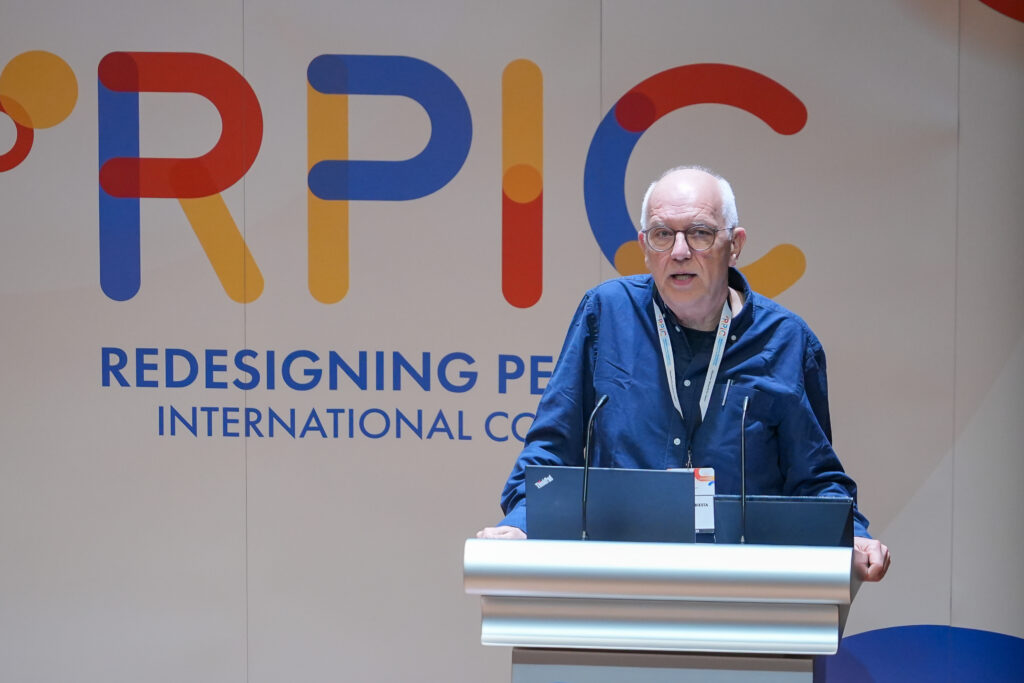
World-centred education has emerged as an alternative way of thinking about the purpose of education. At the Redesigning Pedagogy International Conference (RPIC) 2026, Gert Biesta, Professor of Education at the University of Melbourne, Australia explores how placing the world at the centre of education offers a different way of thinking about teaching, curriculum and what it means to become a person. This article is based on his keynote address, “World-Centred Education: Time for a New Paradigm?” at the RPIC 2026.
“The educational task is to bring the learner and the curriculum into meaningful relation, enabling students not only to acquire knowledge but also to find orientation for living in and with the world. This is what it means to place the world, rather than either the learner or the curriculum, at the centre of education.“
– Professor Biesta on thinking about education
Education has often been organized around two broad traditions: learner-centred and curriculum-centred education. One places the interests and experiences of the learner at the heart of education, while the other gives priority to curriculum and disciplinary knowledge. For Professor Gert Biesta, however, neither offers an adequate starting point on its own. It depends on both.
Instead, he proposes a different way of thinking about education:
“The educational task is to bring the learner and the curriculum into meaningful relation, enabling students not only to acquire knowledge but also to find orientation for living in and with the world. This is what it means to place the world, rather than either the learner or the curriculum, at the centre of education.”
World-centred education, he explains is therefore not another theory of learning, but a theory of education. Rather than asking how learning happens, it begins with the distinctive work of educators and the educational significance of teaching, curriculum and assessment. These are not simply means of producing learning but ways of bringing the world into the educational encounter.
Learning, growth and development describe how people change through their interactions with the world. They matter, but they do not answer education’s own question of “What will students do with what they have learned?”
It is an educational question because it cannot be answered by learning alone. It is also an existential question, concerned with how individuals come to exist as persons who can judge, take responsibility and respond to the world.
To explore this idea further, Professor Biesta turns to the film Jojo Rabbit. The story follows a young boy growing up in Nazi Germany whose closest companion is an imaginary Adolf Hitler. Throughout much of the film, Adolf tells Jojo what to think, what to believe and what to do. As long as that voice speaks for him, there is little need for Jojo to think for himself. As Jojo encounters people and experiences that no longer fit the world he has been taught to accept, that certainty begins to fracture. Gradually, Adolf loses his authority until he disappears altogether. What changes is not simply what Jojo knows, but how he exists in the world, as someone who must make his own judgements and take responsibility for them.
“This illustrates what it means to awaken the person. Such moments cannot be produced on demand, nor can teachers decide when they will occur,” Professor Biesta explains. “They often begin through interruption, when certainty gives way to uncertainty and students are confronted with questions that no one else can answer for them.”
He also points out the distinction between aesthetics and anaesthetics, emphasizing that education should remain open to experiences that move, disturb and awaken while resisting practices that dull the possibility of such encounters.
“If education is concerned with awakening the person, what then is the work of teaching?” Professor Biesta asks.
He describes teaching as an act of pointing. “Rather than directing students towards predetermined conclusions, teachers point beyond themselves towards the world, inviting students to pay attention to something that matters,” he states.
He illustrates this through a simple relationship between the teacher, the student and the world. If the teacher is removed, what remains may still be learning, but it is no longer education. Remove the world, and the relationship between teacher and student risks becoming therapy rather than education. Thus, education depends upon keeping all three in view.
Seen in this way, teaching is not about determining what students should think or who they should become. It is about directing their attention towards the world and leaving space for them to respond in their own way.
Ultimately, the educational question is no longer simply what students know about the world. It asks whether they are willing to let the world address them. Perhaps this is the enduring question that world-centred education leaves us with: What is the world asking of me?
“Rather than directing students towards predetermined conclusions, teachers point beyond themselves towards the world, inviting students to pay attention to something that matters.”
– Professor Biesta describing teaching as an act of pointing
References
Biesta, G. (2022). World-Centred Education: A View for the Present. London and New York: Routledge.