Bridging Physics Concepts through Lesson Study
Contributed by Dr Sundari Prama (Head/Science), with Ms Deborah Roshni and Mr Amos Goh, from Raffles Girls’ School […]
Read More
Contributed by Ms Fazila Banu D/O Mohamed Rabiullah and Ms Jasmine Sujatha from Yuan Ching Secondary School, for SingTeach Virtual Staff Lounge.
When Yuan Ching Secondary School’s English Language and Literature department faced a leadership transition, uncertainty gave way to shared responsibility. Guided by their former Head of Department, now Vice-Principal, a four-person team from the department combined their expertise in curriculum, professional guidance and operations to sustain their work. Teacher Fazila Banu and Senior Teacher Jasmine Sujatha reflect on how distributed leadership has helped the team navigate change and move forward together.
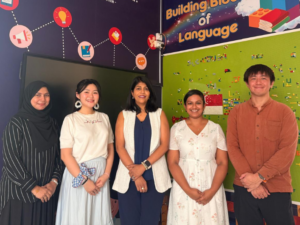
Yuan Ching Secondary School’s English Language and Literature Anchor Team. From left to right: Ms Fazila Banu, Ms Jean Leong, Mrs Buganeish Squires (Former ELL HOD and Current Vice-Principal), Ms Jasmine Sujatha and Mr Isaac Chong.
On a Wednesday morning in late October 2025, the members of the English Language and Literature (ELL) department were invited to arrive 15 minutes early for our Professional Learning Slot. Usually, that extra time was for our monthly birthday celebrations before we started our meeting. But that day, our ELL Head of Department (HOD) announced another piece of news worth celebrating — she had been appointed Vice-Principal (VP) of our school. We rejoiced at the news — an indomitable leader we’d have loved to keep to ourselves. She had arrived at Yuan Ching Secondary School in 2022, after 16 years at Queensway Secondary and 3 ½ years at Orchid Park Secondary School, inheriting a department in the middle of real challenges. What followed was quiet, steady work: she retained experienced teachers who might easily have left and nurtured a wave of beginning teachers into confidence.
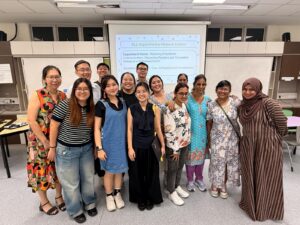
Yuan Ching Secondary School’s English Language and Literature Department
That promotion also signalled the next question. Who would be our next ELL HOD? Who would be our Reporting Officer? What would a department without a HOD look like? The apprehension was immense, but it wasn’t loud.
Assurances were given that she would provide guidance as VP-advisor to the team amidst the uncertainty. Reporting lines shifted. Roles and responsibilities had to be redrawn. Questions remained about the department’s direction and vision. Uncertainty had become the new normal.
Within weeks, the VP-advisor had assembled a four-person team: a Senior Teacher (ST) for English Literature, an Upper Secondary coordinator, a Lower Secondary coordinator, and a teacher who’d wear the hat of Systems-Resources Manager. No one person was in charge because everyone was.
Curriculum planning and assessment for the upper levels rested with the Upper Secondary coordinator. The Lower Secondary coordinator oversaw the same work for the lower levels. Professional guidance, including support for our Flexi-Adjunct and Relief Teachers, became the responsibility of the Senior Teacher, while the Systems-Resources Manager quietly kept the department running by plugging operational gaps and tying up loose ends. Four people, no hierarchy and one department to run.
Of course, truth be told, the load was never perfectly even. Some weeks, one or two of us carried more than the others. That was the honest reality of four teachers taking on leadership work alongside full teaching loads. What held us together was not an equal split of tasks but a shared moral purpose: every decision came back to what our students and teachers needed. We drew on one another’s strengths, whether curriculum know-how, mentoring experience or an eye for systems and detail, and trusted the collective wisdom of the team over any single voice. We often thought of geese flying in a V-formation. When the lead bird tires, it drops back and another moves up to take its place, while the rest of the flock calls out encouragement from behind. That was how we worked. When one of us was stretched thin, another stepped forward without needing to be asked. Whoever happened to be in front, the rest of us were ready and raring to fill whatever gap appeared. No questions were asked.
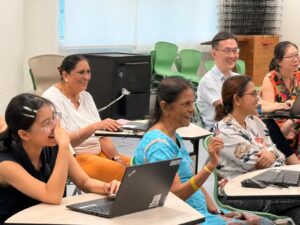
The English Language and Literature Department having a meeting
None of this would have held without the department itself. The ELL department had always believed that our students sat at the heart of everything we did. No teacher ever needed reminding of it, because it was already ingrained in the department, and that shared belief steadied us whenever priorities competed or the weeks ran long. Just as firmly, the department never compromised on its culture of Care, Collegiality and Competence, no matter how hard the journey got. That culture lived in small, ordinary ways. The department kept its monthly birthday celebrations going through the transition. Seasoned teachers sat down with beginning teachers to talk through difficult classes. Colleagues shared resources and refined one another’s lessons during PLC slots, and were even game enough to sit for past-year O-Level Listening Comprehension papers together, comparing who scored highest and who had made the very same mistakes Cambridge flagged as common errors. None of these habits faded when the structure changed. If anything, the department leaned on them more. That culture was the cornerstone everything else rested on, and it is why a department without a HOD never felt like a department without a centre.
Every Friday, without fail, an update landed in our inboxes: professional learning, exam matters, admin, teaching notes, what’s ahead. It became the department’s pulse, proof each week that four people without one person at the helm could still move as one. Yet the structure could only work because the department rallied around it. Experienced teachers readily offered their knowledge and support, while newer teachers stepped forward to contribute in their own ways. Our Contract Adjunct Teachers, Flexi-Adjunct Teachers and Relief Teachers, too, worked within the new lines of responsibility and kept the work moving. Everyone had something to offer. Distributed leadership, after all, depended not only on those taking on formal leadership roles, but also on a department willing to step up and move together.
The synergy-based, non-hierarchical setup mirrored the approach we encouraged in our own students: cultivate agency, make meaning collaboratively, and trust distributed expertise. That philosophy was tested in May 2026, when the VP-advisor went in for surgery and could no longer vet papers or guide teachers. Yet the work continued. Level coordinators took greater ownership of the vetting process, while she continued to provide guidance and coaching where needed during her leave.
Looking back, we wouldn’t have wanted to sail these uncharted waters any other way. We learnt that leadership did not always need to sit with one person, that expertise could be distributed, responsibility shared, and a department held together through collective ownership. Even now, the Friday updates still land in our inboxes without fail. They are proof, perhaps, that Yuan Ching Secondary’s ELL department didn’t just survive the transition. It found its own way of holding itself together in 2026.
“We learnt that leadership did not always need to sit with one person, that expertise could be distributed, responsibility shared, and a department held together through collective ownership.”
– Ms Fazila Banu and Ms Jasmine Sujatha reflecting on the experience