
Knowledge Resource Bank

Children’s Understanding of the Order of Numbers

Numbers are the foundation of mathematical skills. How does numeral order understanding develop in early childhood? And how can we support our children’s understanding of numbers?

How findings from the study can help your students

  • Key Insights
    • Numeral ordering skills predict later mathematics achievement.
    • Young children initially struggle with numeral order (e.g., identifying that 2–5–4 is not in order).
    • Numeral ordering skills become distinct from other early numeracy and general ordering skills as children grow older.
    • Numeral ordering skills are not simply related to knowing the count list; it also reflects an understadning of how the numerical system is put into use.
  • Recommendations
    • Teach numeral order explicitly with ordered and non-ordered sequences, and using consecutive and non-consecutive sequences.
    • Use activities that build understanding of ordinal value.
    • Focus on reasoning about the order of numbers, not just memorisation of the count list.

Introduction to Mechanisms Underlying Numeral Ordering Skills in Children
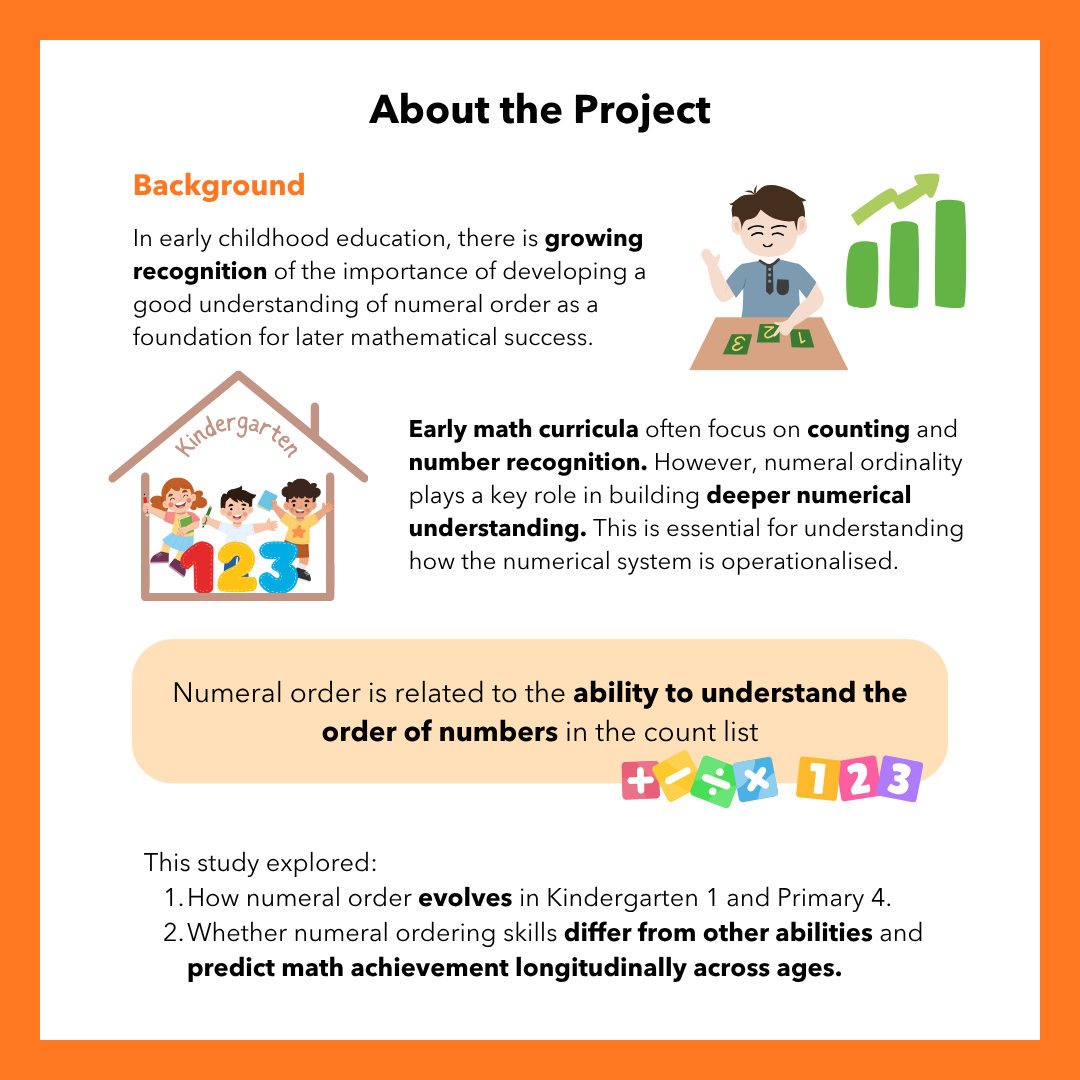
Infographic titled "About the Project: Background." Explains that in early childhood education there is growing recognition of the importance of developing a good understanding of numeral order as a foundation for later mathematical success. Notes that early math curricula often focus on counting and number recognition, but numeral ordinality plays a key role in building deeper numerical understanding, essential for understanding how the numerical system is operationalised. States that numeral order relates to the ability to understand the order of numbers in the count list. Lists the study's two aims: (1) how numeral order evolves in Kindergarten 1 and Primary 4, and (2) whether numeral ordering skills differ from other abilities and predict math achievement longitudinally across ages.


Research Methodology

Infographic titled "How this Research was Conducted." States the study adopted a longitudinal design with computer-based tasks and standardised assessments. Participants: 100 Kindergarten 1 (K1) students and 99 Primary 4 (P4) students. Children were assessed twice — kindergarteners in K1 Term 3 and K2, and primary school students in Primary 4 Term 3 and Primary 5. Children were tested on ordering and early numeracy skills, working memory capacity, and mathematics achievement.


Research Findings

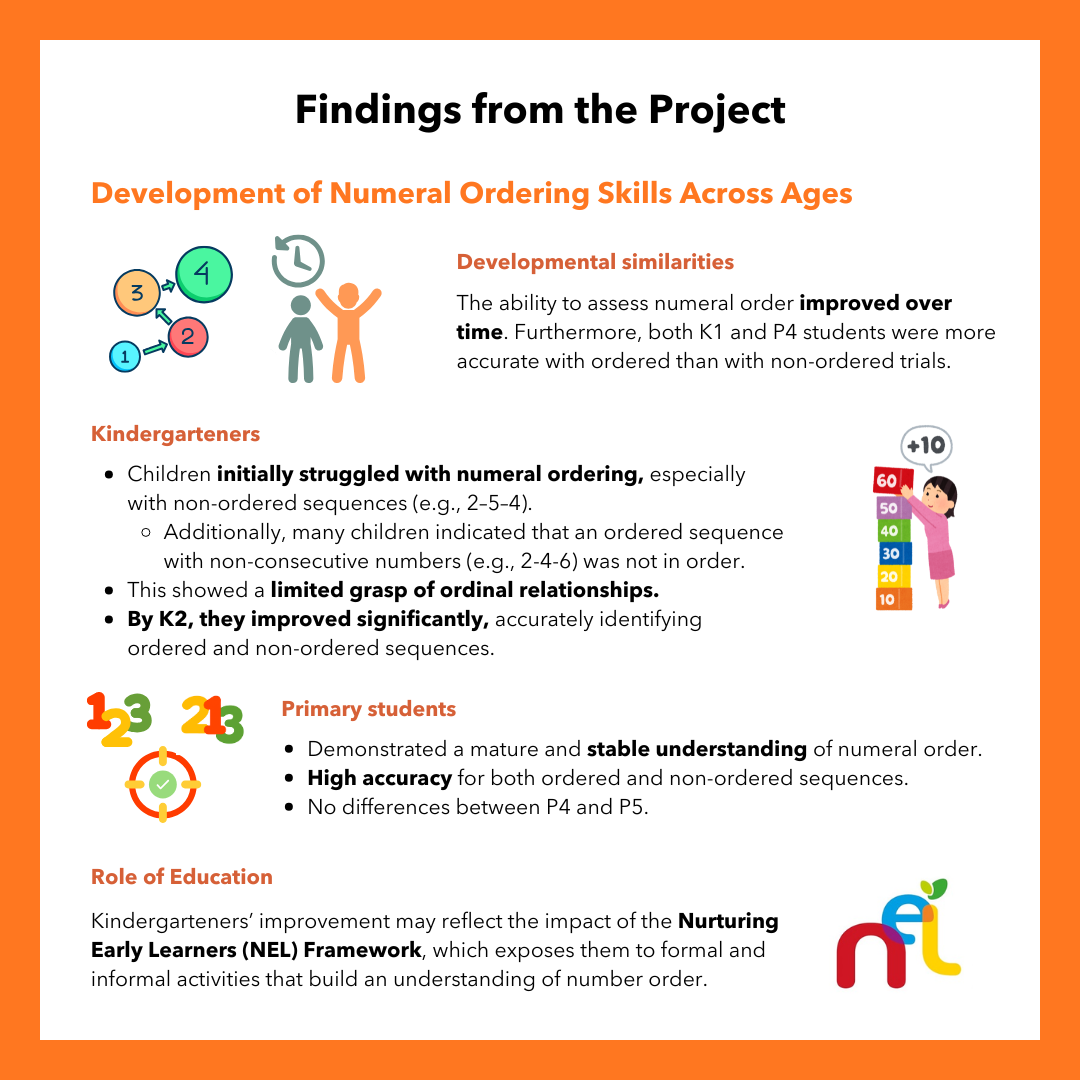
Infographic titled "Findings from the Project: Development of Numeral Ordering Skills Across Ages." Text explains that the ability to assess numeral order improved over time, and both K1 and P4 students were more accurate with ordered than non-ordered trials. Kindergarteners initially struggled with numeral ordering, especially non-ordered sequences (e.g., 2-5-4), with many indicating that an ordered sequence with non-consecutive numbers (e.g., 2-4-6) was not in order, showing a limited grasp of ordinal relationships; by K2 they improved significantly. Primary students showed a mature, stable understanding with high accuracy on both ordered and non-ordered sequences, and no differences between P4 and P5. A final section notes that kindergarteners' improvement may reflect the impact of the Nurturing Early Learners (NEL) Framework.

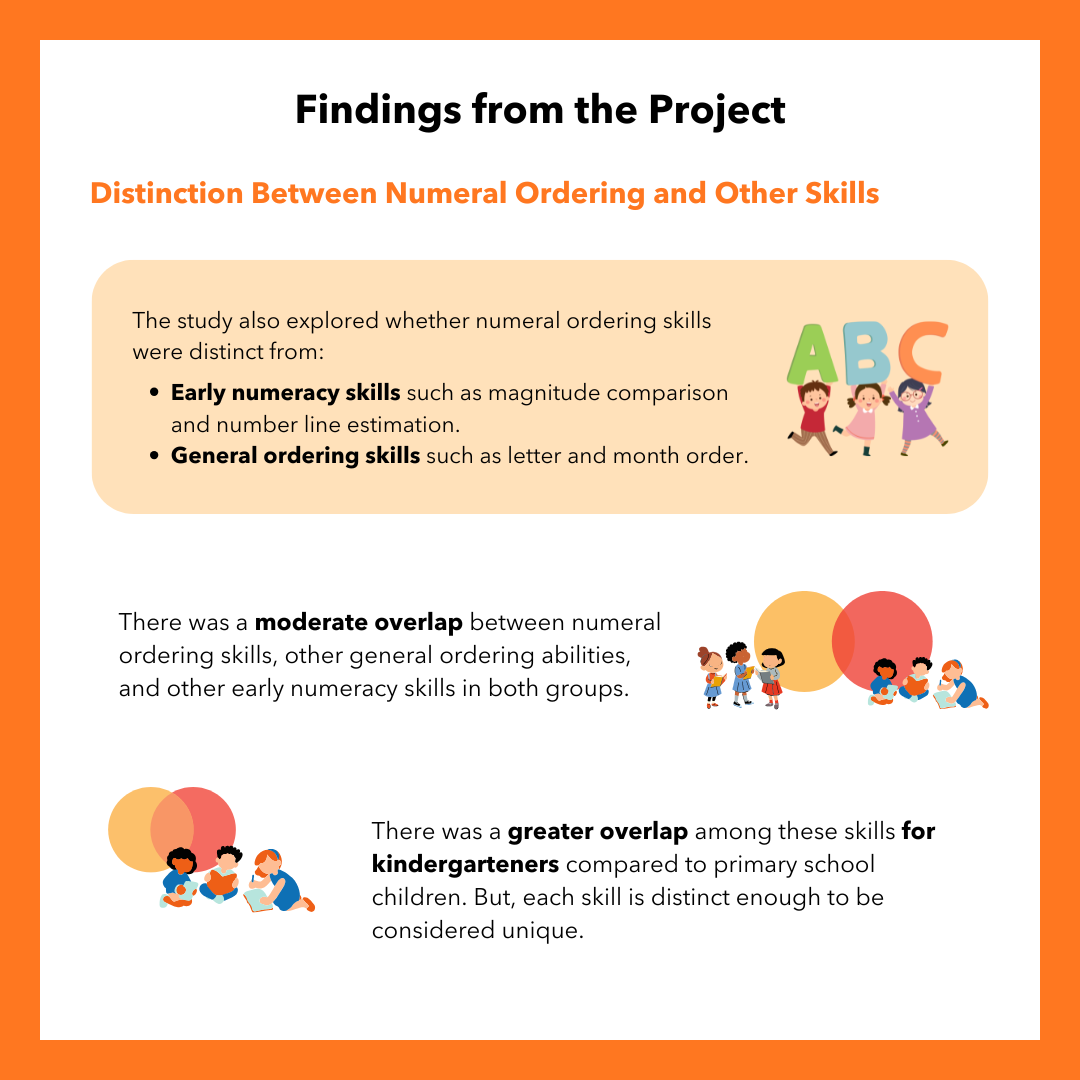
Infographic titled "Findings from the Project: Distinction Between Numeral Ordering and Other Skills." Text explains the study examined whether numeral ordering skills were distinct from early numeracy skills (e.g., magnitude comparison, number line estimation) and general ordering skills (e.g., letter and month order). There was a moderate overlap between numeral ordering, general ordering, and early numeracy skills in both groups, with greater overlap for kindergarteners than primary school children, though each skill remained distinct enough to be considered unique.

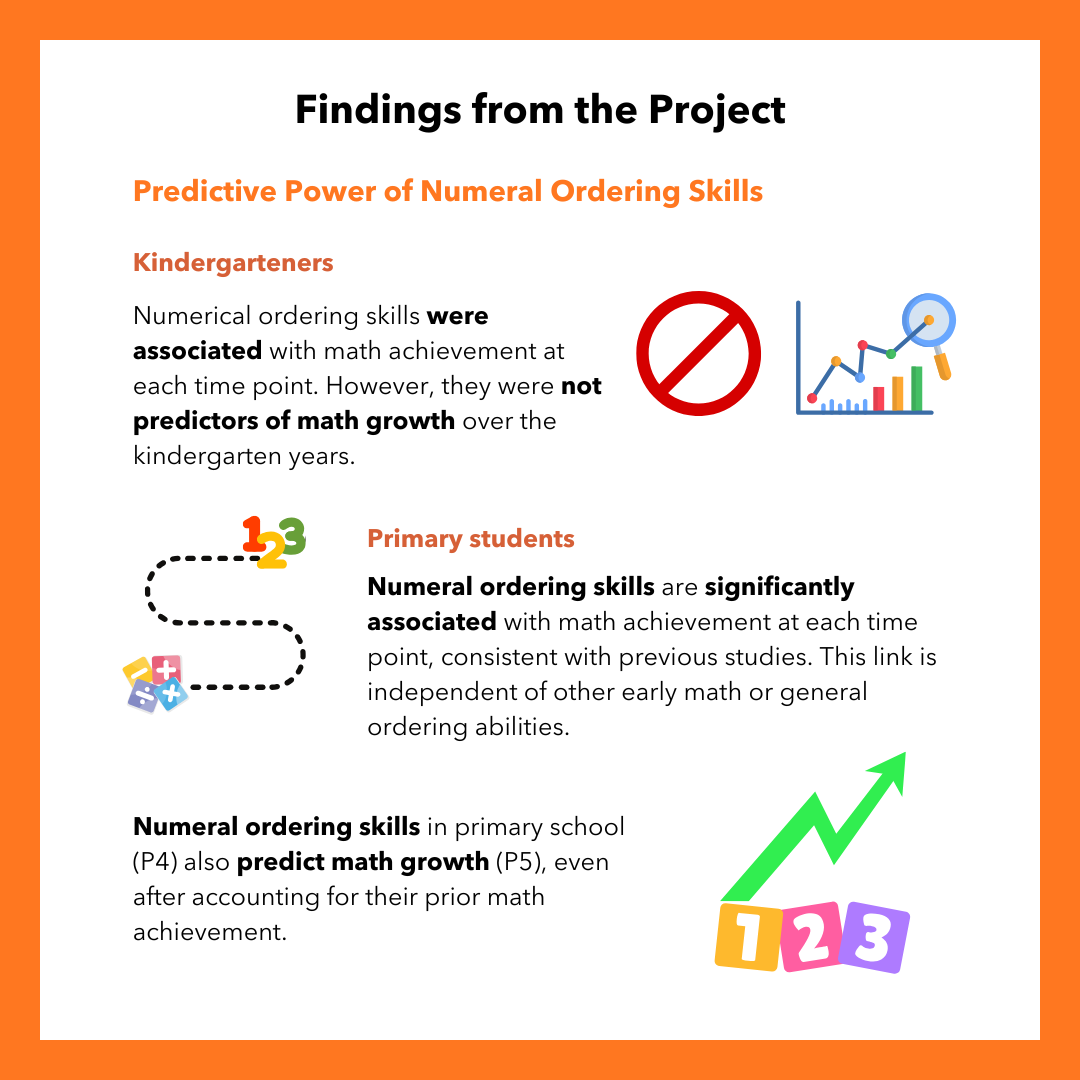
Infographic titled "Findings from the Project: Predictive Power of Numeral Ordering Skills." For kindergarteners, numerical ordering skills were associated with math achievement at each time point but were not predictors of math growth over the kindergarten years. For primary students, numeral ordering skills were significantly associated with math achievement at each time point, independent of other early math or general ordering abilities, and numeral ordering skills in P4 also predicted math growth in P5, even after accounting for prior math achievement.


What Does This Mean for Teaching and Learning?
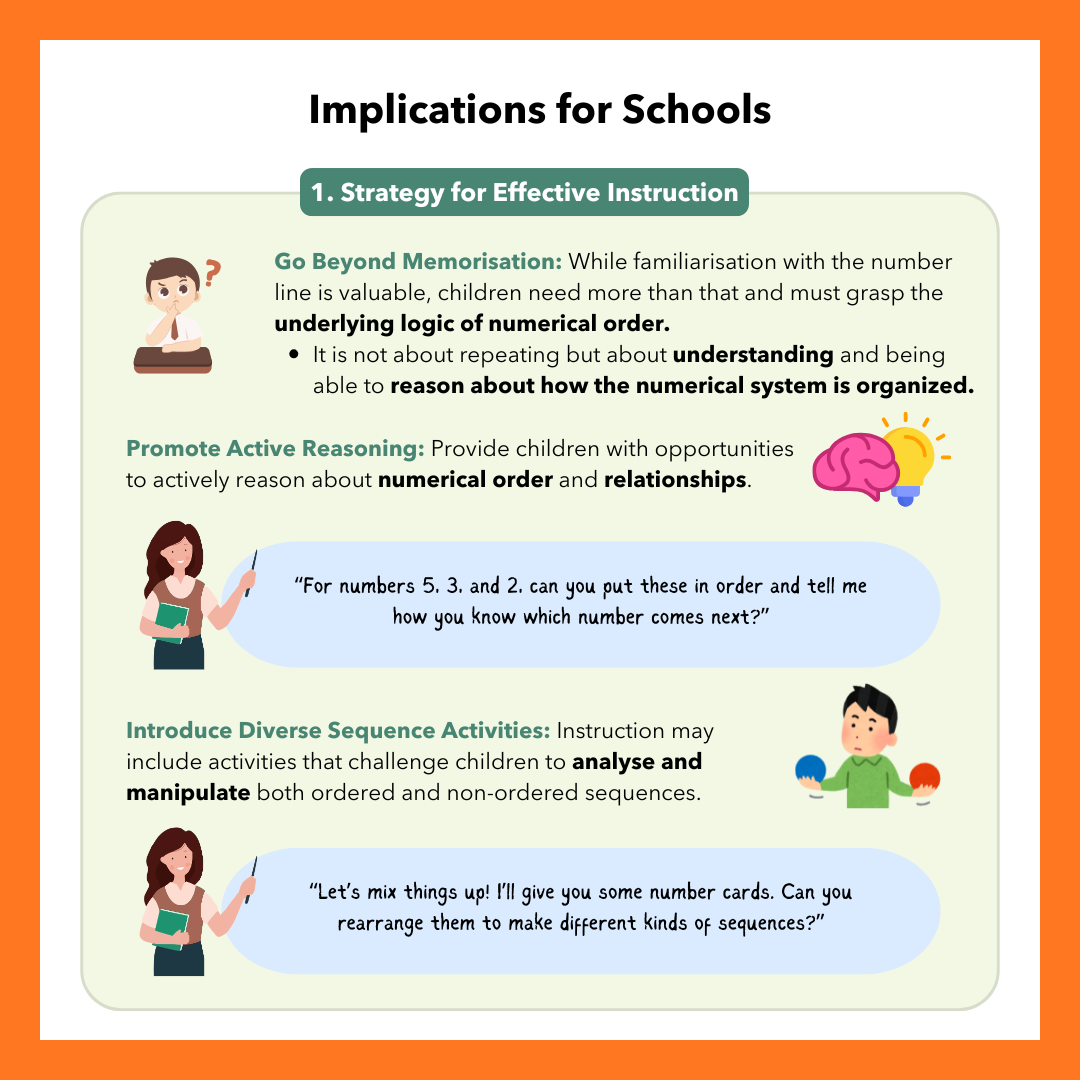
Infographic titled "Implications for Schools: 1. Strategy for Effective Instruction." Recommends going beyond memorisation, since children need to grasp the underlying logic of numerical order, not just repeat a number line. Recommends promoting active reasoning about numerical order and relationships, with an example teacher prompt: "For numbers 5, 3, and 2, can you put these in order and tell me how you know which number comes next?" Also recommends introducing diverse sequence activities that challenge children to analyse and manipulate both ordered and non-ordered sequences, with an example prompt: "Let's mix things up! I'll give you some number cards. Can you rearrange them to make different kinds of sequences?"

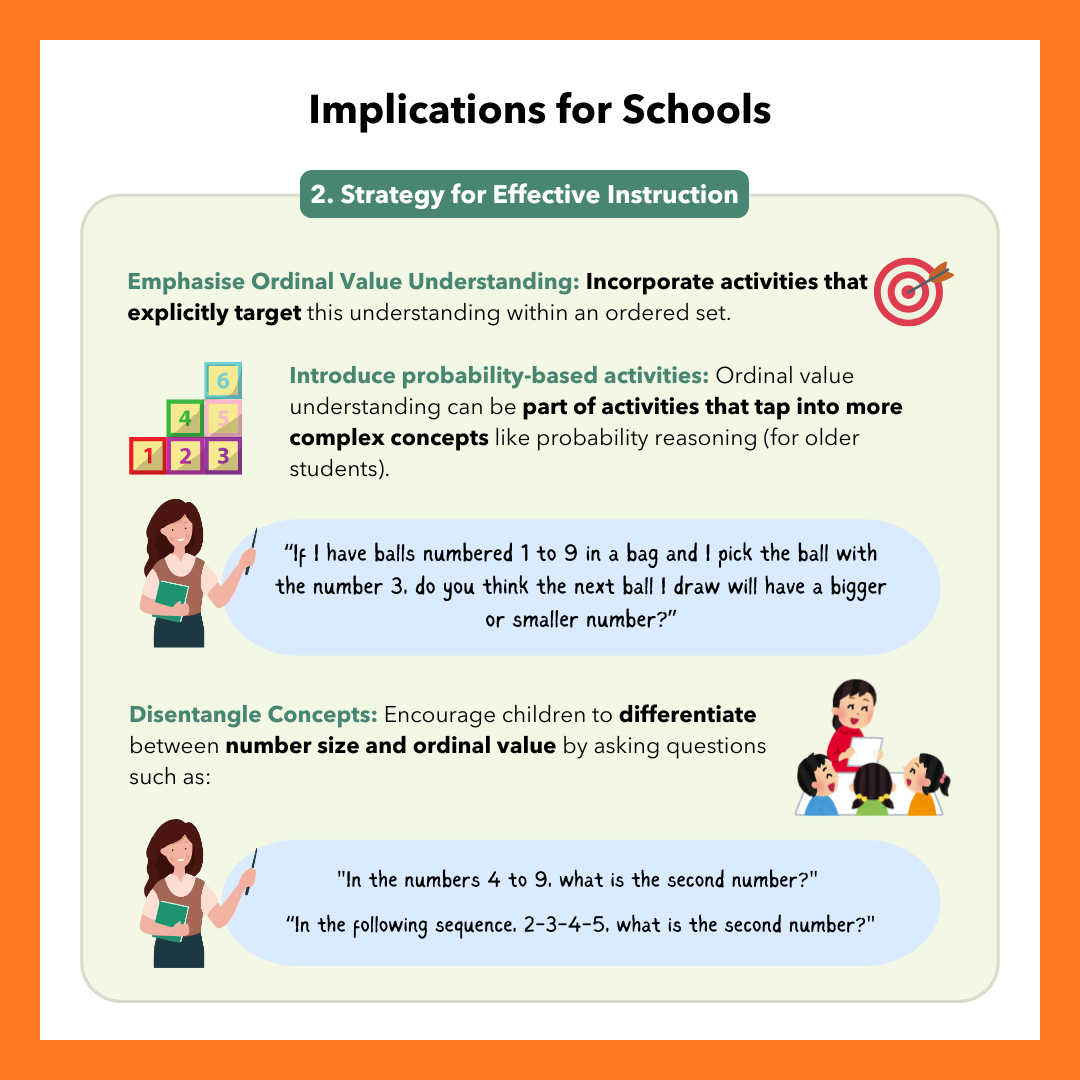
Infographic titled "Implications for Schools: 2. Strategy for Effective Instruction." Recommends emphasising ordinal value understanding through activities that explicitly target this within an ordered set, and introducing probability-based activities for older students, with an example prompt: "If I have balls numbered 1 to 9 in a bag and I pick the ball with the number 3, do you think the next ball I draw will have a bigger or smaller number?" Also recommends helping children disentangle number size from ordinal value with example questions: "In the numbers 4 to 9, what is the second number?" and "In the following sequence, 2-3-4-5, what is the second number?"


Question-Icon Related Links


Question-Icon Further Readings

For educators interested in the research methodology behind Children’s Understanding of the Order of Numbers, you may refer to:


Question-Icon Research Project


Question-IconResearch Team

To learn more about this research, please contact Dr David Muñez at david.munez@nie.edu.sg.

Principal Investigator

  • Dr David Muñez, Assistant Dean, Grant Management, Strategy & Analytics, Office for Research,
    & Senior Research Scientist, National Institute of Education – Centre for Research in Child Development

Acknowledgement

This study was funded by the Education Research Funding Programme, National Institute of Education, Nanyang Technological University, Singapore (project no. OER 05/22 JDMM). Any opinions, findings, and conclusions or recommendations expressed in this material are those of the author(s) and do not necessarily reflect the views of the Singapore MOE and NIE.
This knowledge resource was extracted and reconstructed from the published materials from the research team by Ms Radiah Belak and Ms Shee Yi Xuan, Katherine, with input from Dr David Muñez and Ms Lorraine Ow, and presented on 6 August 2026.

Never Miss A Story