The Conversations Continue: From Research to Impact
What does it mean for education research to make a real difference in schools? That question sat […]
Read More
Artificial intelligence (AI) is rapidly transforming the way students learn, how teachers teach and how knowledge flows in classrooms. But does this also signal the end of the human element that teachers bring to learning? In this article, Dr Alwyn Lee from NIE shares his insights on how AI can extend Knowledge Building opportunities, deepen collaboration and support holistic growth – without replacing the critical role of teachers as designers of learning and stewards of well-being.
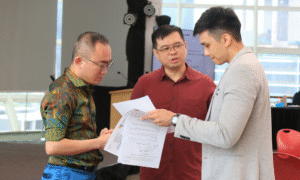
Dr Alwyn Lee (middle) discussing with other participants at a recent Knowledge Building Community Network Learning event.
In recent years, Singapore has made significant strides in exploring how AI can shape the future of education. Researchers, practitioners and policymakers have been observing the emergence of a range of technological advancements, from adaptive learning platforms that personalize instruction to automated assessment tools that provide rapid feedback.
“AI has been positioned as a catalyst for rethinking teaching and learning,” Dr Alwyn Lee, an Education Research Scientist from the Office for Research at NIE, says. “Singapore has set up initiatives that are built on national efforts to cultivate 21st Century Competencies (21CC). This ensures that students not only excel academically but also develop the critical thinking, adaptability and resilience needed in an uncertain world.”
However, he cautions that alongside these technological possibilities lies an equally important consideration: students’ use of AI and its impact on their well-being. He raises a timely question: As classrooms become increasingly digitalized, how can we safeguard students’ emotional and cognitive balance while preparing them for the demands of the future?
“A critical balance lies in promoting student agency that help learners make inquiries, reflect and even challenge the feedback that AI systems provide.”
– Alwyn, on the importance of student agency
NIE has been playing a vital role in developing AI-enabled platforms that offer deeper insights into how students learn. One such research-based innovation is EmoSense, an AI tool designed to detect students’ epistemic emotions—such as enjoyment, boredom and confusion – during learning activities.
Currently implemented in the student Knowledge Building Design Studio (sKBDS), EmoSense provides teachers with valuable information about students’ emotional states that were once difficult to observe.
“By making these signals more visible, the tool does not replace the teacher but enhances the teacher’s ability to respond empathetically and adaptively to students’ learning needs during Knowledge Building (KB),” he notes.
At the same time, he emphasizes that AI in classrooms must be approached with care to ensure that students do not become passive recipients of machine-driven decisions.
“A critical balance lies in promoting student agency that help learners make inquiries, reflect and even challenge the feedback that AI systems provide,” he explains.
In an idea-centric KB environment enhanced by AI, he notes that students should be encouraged not only to ask questions, but also to engage with AI as a co-constructor of knowledge.
“For example, by correcting an idea proposed by the AI or affirming their epistemic emotion determined by AI-enabled EmoSense, students are not only exercising autonomy but also developing metacognitive awareness of their own learning and emotional processes in the midst of AI agents,” he says.
For educators, the growing presence of AI in schools presents both opportunity and reflection. Alwyn reminds us that while it is easy to be fascinated by the latest tools and technologies, the true focus of education should remain on nurturing students’ capacity to think, create and connect ideas meaningfully.
“Our larger concern should still revolve around idea-centric practice that delivers relevant and authentic content that elevates students’ understanding,” he notes. “One of the key questions that we should be asking is: how do we use AI to extend the possibilities of KB, deepen collaboration and support holistic growth in our students?”
One of the ways AI could be meaningfully integrated in schools is through deepening collaborative efforts between researchers and teachers. A recent partnership between NIE and Fairfield Methodist School (Primary) on a Generative Pre-Trained Transformers (GPT) chatbot called Fairbot exemplifies this approach1. Together, the team co-developed Fairbot’s prompt flows and lesson plans, aligning them with subject-specific frameworks such as the FAST model in Chinese and KB principles in Science.
“The partnership enabled teachers and researchers to jointly deliver lessons and conduct classroom observations with 94 Primary 5 students. The team also used thematic coding to capture both pedagogical design insights and student learning experiences,” Dr Katherine Yuan, Education Research Scientist from NIE’s Centre for Research in Pedagogy & Practice and Office for Research, explains.
The results have been encouraging. What began as a classroom collaboration has since grown into scholarly dissemination, with findings presented at international conferences such as ICLS 2025.
“Our work highlights how co-designing AI integration supports both student learning and teacher professional growth, offering a new approach for advancing classroom innovation with generative AI,” Katherine notes.
Agreeing, Alwyn adds that the role of teachers remains as vital as ever in the age of AI.
“In the age of AI, the teacher’s role is to provide additional value to the classroom as a designer of learning, a guide to agency and a steward of well-being, all of which are no less essential, just because we have added AI into our learning environments,” he affirms.
“In the age of AI, the teacher’s role is to provide additional value to the classroom as a designer of learning, a guide to agency and a steward of well-being, all of which are no less essential, just because we have added AI into our learning environments.”
– Alwyn, on the enduring role of a teacher
1The Fairbot team that contributed to this article consists of Dr Katherine Yuan from NIE, and Mrs Soh Mei Foong, Mrs Yap Tsui Lan, Mrs Chen Siyun and Mrs Joy Au from Fairfield Methodist School (Primary).