The Conversations Continue: From Research to Impact
What does it mean for education research to make a real difference in schools? That question sat […]
Read More
Discover how Knowledge Building (KB) is transforming teaching and learning in Singapore schools. Through the eyes of educators at Damai Secondary School and St. Hilda’s Primary School, this article highlights student-centered classrooms, collaborative idea growth and the professional development opportunities that emerge when teachers and students become co-creators of knowledge. See how KB fosters critical thinking, creativity and agency for both learners and educators.
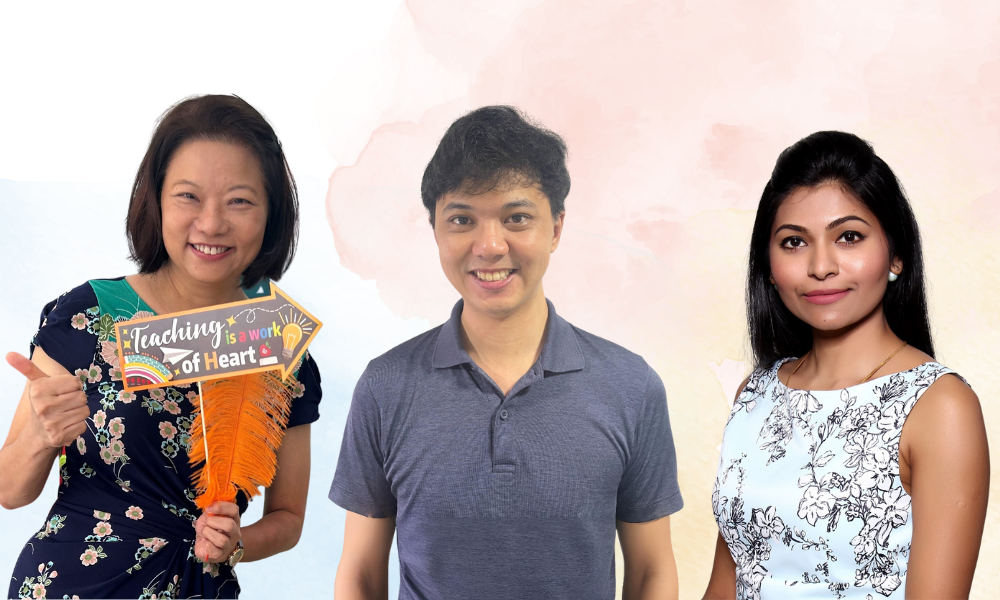
From left to right: Mdm Law Li Mei, Mr Lin Jie Hui, Mdm Ushanthini Arumugam
Mdm Law Li Mei, Principal, St. Hilda’s Primary School
During my sabbatical leave in 2023, I did a short attachment at NIE’s Centre for Research in Pedagogy and Practice, where I explored several teaching and learning research projects that my school could consider for scaling pedagogical practices.
Knowledge Building (KB) particularly caught my attention because of its alignment with approaches already widely adopted at Fairfield Methodist School (Primary), including the development of students’ creative and adaptive thinking, maker education, and the 21CC curriculum. KB is not just another teaching tool – it bridges subjects and provides authentic, real-world learning experiences.
With teacher facilitation, students take ownership of generating ideas, collaborate to improve them, and gain deeper insights. I was encouraged to see that even low-progress students benefitted from KB scaffolding, producing artefacts that demonstrated quality thinking and achievement of learning objectives.
Upon my posting to St. Hilda’s Primary School in 2024, I observed KB pedagogy already embedded in parts of the curriculum, especially the gifted science programme. Cross-department collaboration and sharing of KB practices has enabled teachers to integrate KB regularly into lesson design and facilitation. Being part of both schools allowed me to foster wider collaboration and networked learning among teachers.
A key strength of KB is the support of the KB Networked Community for Teachers. Regular gatherings of practitioners in Singapore and abroad have inspired teachers to design diverse lessons using KB scaffolds. Emerging tools such as AI and learning analytics developed by CRPP further excite teachers in an increasingly digital learning environment. I am also exploring collaborations with overseas KB-focused institutions for professional development and student exchange programs to enrich the enactment of the 21CC curriculum.
Mdm Ushanthini Arumugam, St. Hilda’s Primary School
A student-idea-centric classroom leaves a lasting impact on both students and teachers. I vividly remember my first KB lesson: as one group’s ideas were spotlighted, the entire class built upon them. Surprisingly, learning objectives were met, yet discussions remained candid and fluid, with students’ perspectives guiding my teaching.
Using KB prompts such as “I need to understand” or “This theory doesn’t explain,” students engage in critical and inventive thinking while communicating their ideas mindfully. Their voices take centre-stage, shaping discussions and demonstrating agency, while teachers shift from content providers to facilitators of idea growth.
At St Hilda’s Primary, KB enacts MOE’s 21st Century Competencies. Through the KB pedagogical cycle, students develop critical thinking, collaboration and communication skills, becoming confident and adaptable learners prepared for a complex, changing world.
My first KB Cloud revealed students’ naïve ideas and misconceptions far more effectively than pre-quizzes or guides, transforming the way I frame questions and lessons. Over time, KB prompts and sentence starters became a natural part of classroom culture, fostering ownership and collective advancement of knowledge.
Equally inspiring is the KB teacher community. Witnessing colleagues engage deeply with student ideas, adapt practices, and grow professionally has become as rewarding as seeing students thrive. KB captures the essence of both student and teacher agency.
Mr Lin Jie Hui, Damai Secondary School
I discovered KB whilst exploring approaches to increase student engagement. What intrigued me was not just its student-centric approach, but its recognition that students learn best as active contributors rather than being passive consumers of ideas and knowledge.
Since implementing KB in Social Studies and Mathematics, I consistently observed meaningful student engagement. Students became active contributors, sharing initial ideas across topics from Citizenship, Diversity and Globalization to Mathematical concepts. Discussions extended beyond these ideas as students sought improvements, engaged in meaningful discourse, and co-constructed deeper understanding through collaborative idea refinement.
I’m professionally supported by the KB Network Learning Community and NIE researchers who truly appreciate practitioners’ groundwork. This community enabled new experiences: writing research papers, presenting at conferences and conducting workshops. Through these experiences, I gained valuable insights from collaborative discourse with fellow practitioners and cultivated essential competencies to navigate education’s evolving demands.
KB offers practitioners lifelong intellectual stimulation. Each lesson brings new questions and insights. As a research-grounded approach with key guiding principles, KB represents an innovative frontier for engaging more meaningfully with students.
Subscribe to our newsletter to receive the latest information about our articles and events. Email us at sgteach@nie.edu.sg for assistance.
On topics related to teaching and learning, we invite you to contribute articles that focus on the following:
We welcome contributions that explore how educators are shaping the future of learning in a rapidly changing world marked by technological advancements and global challenges.
If you have a classroom or education research story to share, we invite you to send in your contribution articles.
Submit your contribution here:
SingTeach complies with the Personal Data Protection Act 2012 of Singapore
For questions, please contact the editorial team: sgteach@nie.edu.sg