The Conversations Continue: From Research to Impact
What does it mean for education research to make a real difference in schools? That question sat […]
Read More
Secondary school
Character and Citizenship Education

 Theory of Mind
Background
Key Recommendations
 The Importance of Theory of Mind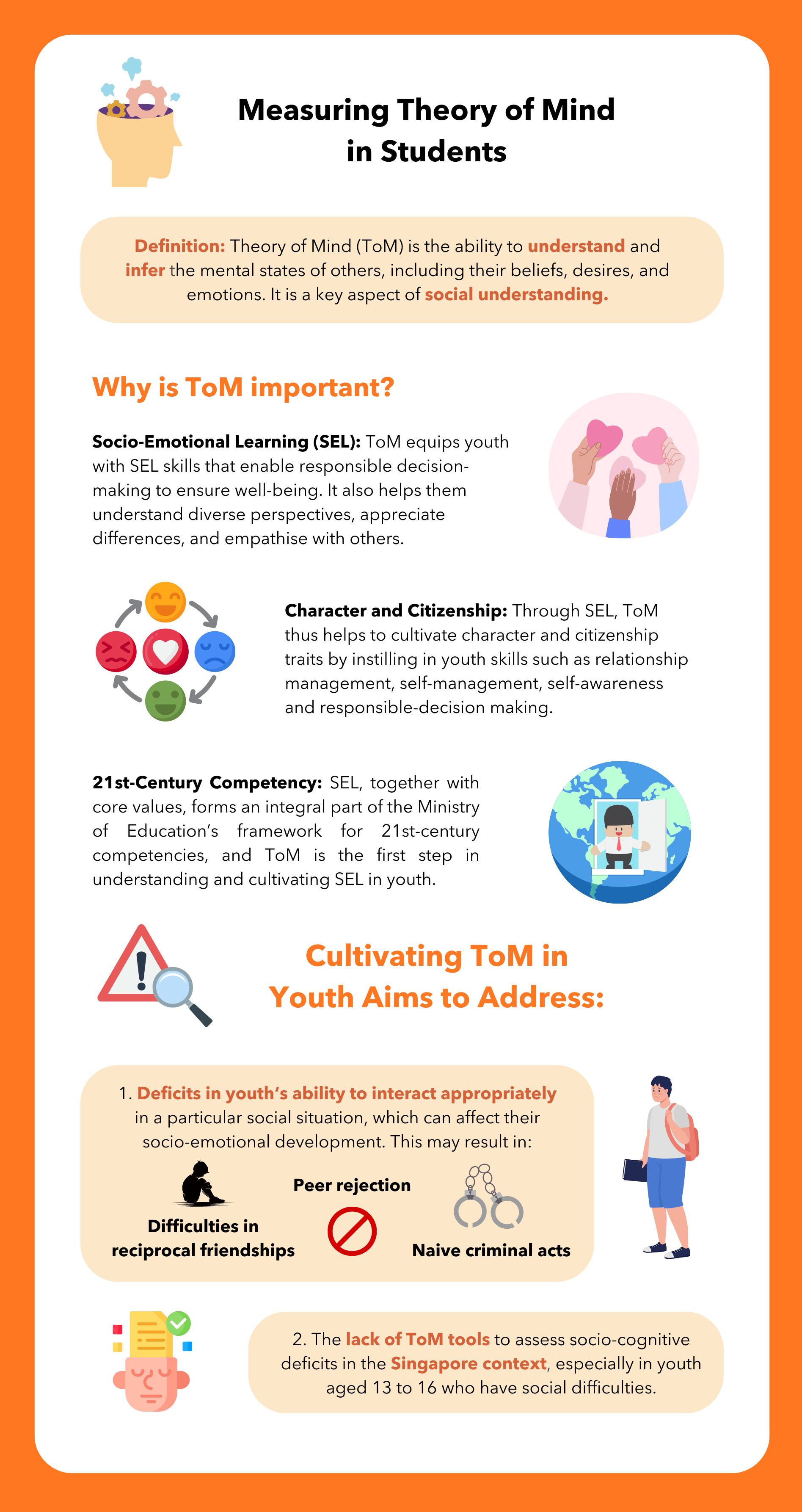
 Development of the Youth-Theory of Mind (Y-ToM) Singapore Version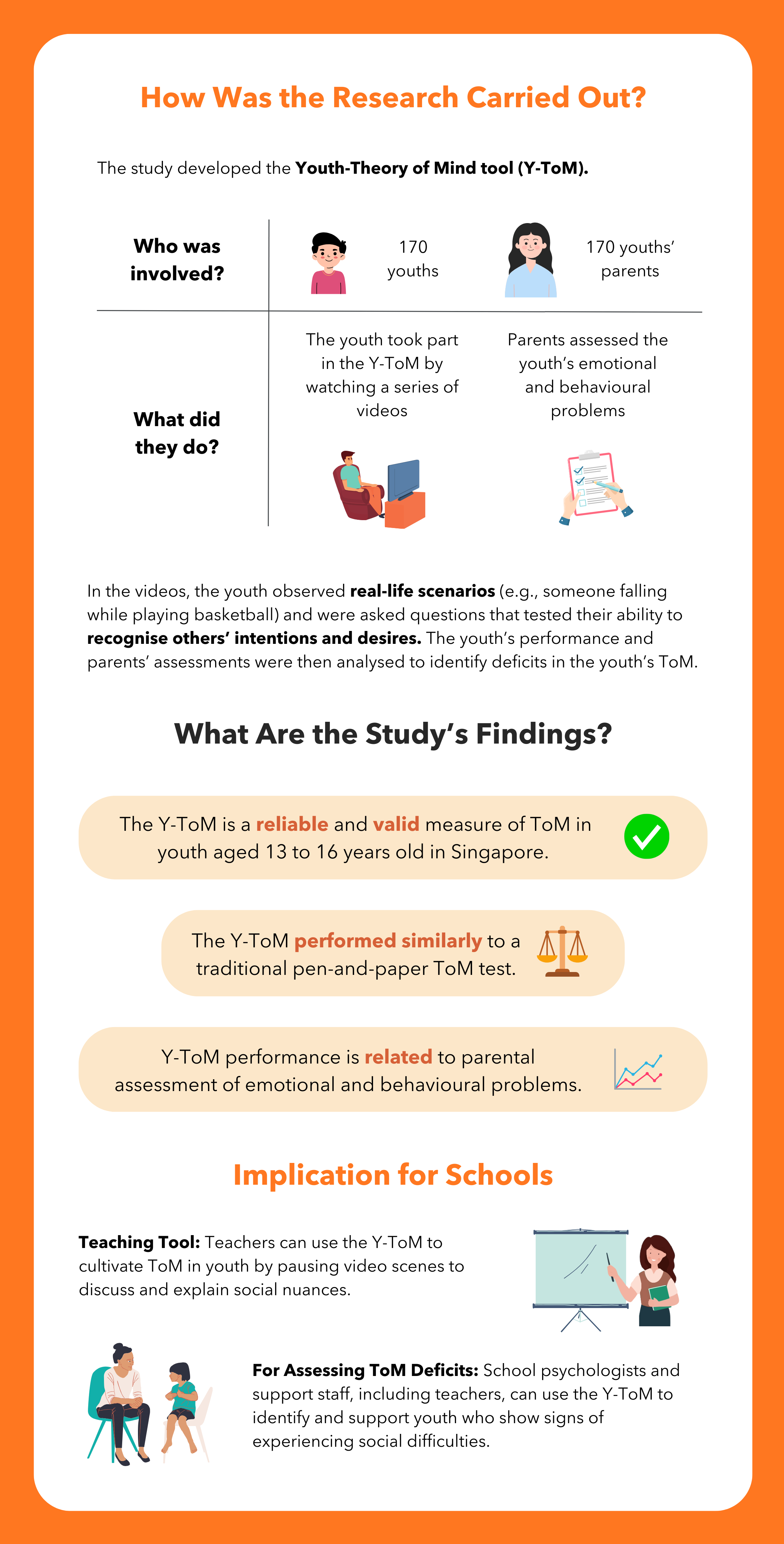
 How Can the Y-Tom Be Used in Schools?
The Y-ToM comprises two sets of items: 14 Social videos and 8 Physical videos. These can be used by teachers and educational psychologists or counsellors to measure ToM in youths aged 13 to 16.
The Social videos evaluate the examinee’s capacity to interpret a speaker’s intentions across seven categories: (1) lie; (2) white lie; (3) misunderstanding; (4) double bluff; (5) figure of speech; (6) sarcasm; and (7) persuasion. Each category includes two items for assessment.
The Physical videos, on the other hand, require logical reasoning to decipher the characters’ utterances or behaviours.
Fundamentally, the Social videos serve as a means to identify social challenges, while the Physical videos function as control videos. This implies that individuals facing social difficulties are expected to perform reasonably well on the Physical videos but might struggle with the Social videos.
Access the Y-ToM videos here:
Social: https://www.youtube.com/watch?v=re6i8u1R4_Y&list=PL4NPNFHEd_BEQXvsLWNPo6pl2xP_yukrK
Physical: https://www.youtube.com/watch?v=abqW8gHipPE&list=PL4NPNFHEd_BEcovCqtmUMY-ftvGTcdZri
 What Can School Practitioners Do?
Teachers can use the Y-ToM to cultivate ToM by asking questions about social nuances. Teachers have to come up with their own questions for the videos. Some examples might be “Why did Rachel say that “she loves the gift”?” for this Social video and “Why did he buy 5 donuts?” for this Physical video. Teachers can also help students look at the nonverbal communication cues in the videos (e.g., body language, facial expressions, tone of voice, etc.) to identify social cues.
Educational psychologists and counsellors can administer the Y-ToM to assess ToM deficits and provide tailored support as needed.
 Related Links
 Further Readings
For educators interested in finding out more about the traditional pen-and-paper ToM test, you may refer to:
 Research Projects
The following projects are associated with the Theory of Mind project
Research TeamTo learn more about this research, please contact Asst Prof Nah at yonghwee.nah@nie.edu.sg
Principal Investigator
Assistant Professor Yong Hwee NAH, Psychology and Child & Human Development, National Institute of Education, Nanyang Technological University, Singapore (NIE NTU, Singapore)
AcknowledgementsDevelopment of the Youth-Theory of Mind (Y-ToM) Singapore Version was funded by the Education Research Funding Programme, NIE NTU, Singapore (project no. OER 31/17 NYH). Any opinions, findings, and conclusions or recommendations expressed in this material are those of the author(s) and do not necessarily reflect the views of the Singapore MOE and NIE.
This knowledge resource was extracted and reconstructed from the published materials from the research team and presented by Ms Radiah Maria Belak on 30 October 2023.