The Conversations Continue: From Research to Impact
What does it mean for education research to make a real difference in schools? That question sat […]
Read More
Students found using MGB intuitive and easy to use. More importantly it facilitated their awareness of teamwork and how to improve. A student revealed: MGB was “very important for keeping track of our progress… so that we can do something to help the situation… If we don’t improve, we can reflect, how can we do better. [This]… makes group work a better learning experience for us.”
Another student highlighted that “the team micro-profile, it is interesting as it captures the attention of the students. It enables them to see things… in a way they will not see otherwise. This is very useful especially when determining strengths and weaknesses”.
Teachers found that MGB is an all-in-one platform that housed all resources that teachers needed for the MGB lesson, tools for progress tracking and monitoring, target setting, discussions and reflection – “The user-friendliness of the dashboard will surely facilitate the engagement of MGB by students as students can do own navigation without being told where to go by the teacher(s). The ease of putting up/ uploading of lesson materials.”
A teacher also shared that upon completion of the intervention, she is convinced of the effectiveness of MGB – “I am now a believer in the power of reflection to get students assessing their personal and peers’ teamwork skills.” and “It(MGB) got them thinking and reflecting about their own teamwork competencies. They also learnt the importance of teamwork.”
Secondary school
Interdisciplinary Project Work (project-based)
Design and Technology (project-based)

 How MGB Can Help Your Students
MGB is an intervention stemming from a formative learning analytics pedagogy, focusing on four teamwork dimensions and housed on a web-based software.
It can help to sensitize students to their personal teamwork competencies, becoming more purposeful in learning the competencies in team settings.
It helps teachers to better understand their students’ teamwork behaviours, allowing teachers to Systematically nurture these behaviours in students.
It equips teachers with tools (i.e., MGB platform) to scaffold the teaching and learning of teamwork competencies.
 Why MGB?
MGB enables teachers to nurture their students’ teamwork competencies. Ready-to-go and easy-to-use, MGB is versatile and can be used in any subject that includes a two to six month collaborative inquiry task.
What is MGB?
MGB is a digital formative assessment approach and software to nurturing teamwork competencies. It focuses on four teamwork dimensions and is co-designed by researchers, educators, web developers and policy makers. The pedagogical approach is Team and Self Diagnostic Learning (TSDL) which utilizes learning analytics in a formative manner and is aligned with the Singapore Teaching Practice.
What are the Features in MGB Software?
Teacher dashboard
How Does MGB Work?
What’s the Team and Self Diagnostic Learning (TSDL) Framework?
Undergirding MGB is the TSDL framework – a pedagogical approach that uses formative learning analytics to nurture students’ teamwork competencies.
Four Stages of the TSDL model
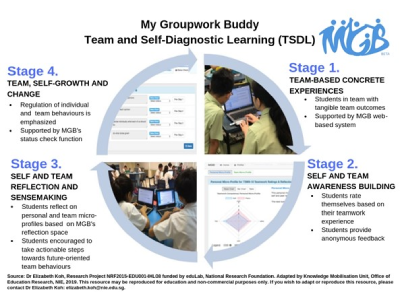
Stage 1: Team-Based Concrete Experiences
To activate teamwork behaviours, students are situated in a team setting with tangible team outcomes. Collaborative learning is supported by MGB web-based software:
MGB chat – a platform for students’ online discussion
Stage 2: Self and Team Awareness Building
Through the rating function on MGB, students rate themselves and team members and provide peer comments anonymously based on their recent teamwork experiences.
The student dashboard displays students’ peer comments as well as aggregates ratings into Personal and Team Micro-Profiles on four teamwork dimensions to raise students’ awareness of their personal and team’s teamwork competencies.
The four teamwork competency dimensions are
Team Emotional Support – supporting team members emotionally and psychologically
Stage 3: Self and Team Reflection and Sense Making
Guided by MGB’s reflection space, students reflect on the information acquired from their personal and team micro-profiles, first individually and then as a team. Students are then encouraged to take actionable steps to improve on future-oriented team behaviors.
Stage 4: Team and Self-Growth and Change
In this stage, students are encouraged to continue their team-based project work through MGB where a Teamwork Steps Status Check function is provided to help students monitor their progress on the steps they have set individually and as a team. This emphasizes the regulation of the individual and the team on their behaviors, which are key mechanisms for changing attitudes and actions.
 Evidence from MGB research
How did students respond?
Students also commented that as they monitored their progress on goals over time, they find themselves to be more metacognitively aware of their teamwork tendencies in terms of understanding their current perceptions and/or intentions for improvement.
In addition, Teachers who Participated in the Research Noted:
Design and delivery of group-based collaborative inquiry tasks
Tracking of student progress and their teamwork competencies for any necessary follow-up actions
Develop a better understanding of the concept of teamwork and the competencies dimensions involved when working in a team
Heightening teachers’ insights and understanding of their students
Understanding team dynamics of how and why students behave in certain ways
Teachers also shared that their role and involvement in research has expanded as a teacher, facilitator, co-designer of learning experiences and environments and practitioner researcher through this project.
Overall, there is a general sense of fulfilment and achievement as teachers grow in their professional competencies to facilitate and teach teamwork competencies. As teachers see meaning in teaching teamwork competencies in their classes, they are convinced of its place in the education of their students.
How Can Teachers Get Started?The MGB software can be used in schools with support from their internal IT to deploy the system on their school web server. The school can contact the PI for more information.
MGB lesson package is also available for teachers as a downloadable pdf with accompanying slides. Alternative technologies are also provided in the lesson package if the school does not use the MGB software.
 Related Links
 Further Readings
Koh, E., Hong, H., & Tan, J.P-L. (2018). Formatively assessing teamwork in technology-enabled twenty-first century classrooms: exploratory findings of a teamwork awareness programme in Singapore. Asia Pacific Journal of Education, 38(1), 129-144.
Koh, E., Tan, J. P-L., Hong, H., &. Tee, Y-H. (2018). Growing teamwork competency: A mixed methods study of an iterative digital formative assessment approach. In 13th International Conference of the Learning Sciences (pp. 1461-1462). London, United Kingdom: International Society of the Learning Sciences.
Advani, V. K., Koh, E., Tee, Y. H., Suresh, D., & Tan, J. P-L. (2018). Enhancing a techno-pedagogical tool for student teamwork growth. In Proceedings of the 26th International Conference on Computers in Education (pp. 181-186). Manila, Philippines: Asia-Pacific Society for Computers in Education.
Tee, Y. H. & Koh, E. (2018). A Digital Formative Assessment of Teamwork in Collaborative Inquiry Student Teams. In Proceedings of the 26th International Conference on Computers in Education (pp. 7-10). Manila, Philippines: Asia-Pacific Society for Computers in Education.
Koh, E., Tan, J.P-L., Hong, H., Suresh, D., &, Tee., Y-H. (under review). Infusing the teamwork innovation My Groupwork Buddy in schools: Enablers and Impediments.
 Research Projects
The following projects are associated with MGB research :
Research TeamFor enquiries on MGB, please contact the Principal Investigator Dr Elizabeth Koh at elizabeth.koh@nie.edu.sg.
Principal Investigator
Dr Elizabeth KOH, Office of Education Research (OER), NIE
Co-Principal Investigators
Ms Helen HONG, CRO, MOE
Collaborators
AcknowledgmentsThis research on MGB was funded by National Research Foundation (NRF), Singapore under the eduLab Programme (NRF2015-EDU001-IHL08) and administered by National Institute of Education (NIE), Nanyang Technological University, Singapore. Any opinions, findings, and conclusions or recommendations expressed in this material are those of the author(s) and do not necessarily reflect the views of the Singapore NRF and NIE.
This knowledge resource was written by Ms Lyndia Teow and Ms Tan Giam Hwee and edited by Ms Tee Yi Huan and Dr Elizabeth Koh in 2020; updated by Ms Monica Lim on 30 December 2021.