

Learning to Thrive: The Science of Learning and Student Well-Being
Learning has always been at the heart of education. Increasingly, however, educators are recognizing that how students learn […]
Read More
Contributed by Dr Ho Siew Yin and Sng Wei Qin Abbie, from NTUC First Campus, for SingTeach Virtual Staff Lounge

In preschool years, mathematics learning is often framed as the learning and development of foundational numeracy concepts and skills, such as relationships and patterns, counting and number sense, and shapes and spatial concepts (MOE, 2023, p.12). Yet, at the core of meaningful learning of mathematics and problem-solving lies something more: Children’s voices. Listening to children express their mathematical ideas and reasoning offers profound insights into their mathematical sense-making and mathematical agency.
In his book, Learning to Think Mathematically: Problem Solving, Metacognition, and Sense Making in Mathematics, renowned mathematics education researcher, Alan Schoenfeld, highlighted that developing mathematical sense making is about developing a mindset that appreciates and uses mathematical concepts or situations by connecting them with prior knowledge, engaging meaningfully, reasoning logically and developing insights about them, rather than just memorizing procedures (Schoenfeld, 1992). Boaler (2000) highlighted that mathematical agency involves giving learners the opportunity to ask questions, the space to propose ideas, critique ideas and take charge of their own learning, thereby fostering deeper understanding and engagement in mathematical problem solving. This is in contrast with traditional classrooms where the authority lies with the teacher and students are passive receivers of instruction.
Both mathematical sense-making and mathematical agency emphasize empowering learners and encouraging their active participation in creating mathematical meaning for themselves. To foster this empowerment in young children, it is vital that teachers value children’s voices in mathematical problem-solving classrooms.
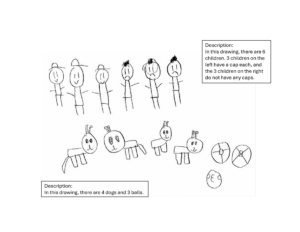
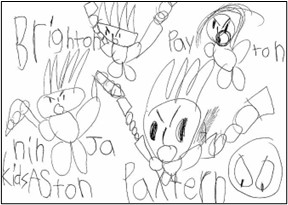
Children communicate their mathematical thinking and ideas in varied ways – not only through words (verbal) but also through gestures, drawings and even the use of physical objects such as blocks (non-verbal). This non-verbal mode provides young children a way to express their mathematical understanding, especially when they are too young to express complex ideas in words. Hence, these two modes, verbal and non-verbal provide insights into how young children construct mathematical knowledge as well as their understanding of mathematical concepts.
Further, when teachers value children’s voices, it can reveal how children understand their family, their community and the environment which they live in.
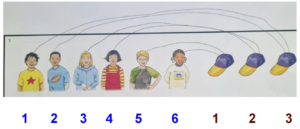
As part of a recent study by NTUC First Campus, preschool children were asked to solve mathematical story problems – the “Dogs-and-Balls Problem” and the “Children-and-Caps Problem”. These two problems were obtained from the Brigance Early Childhood assessment tool (Brigance, 1992).
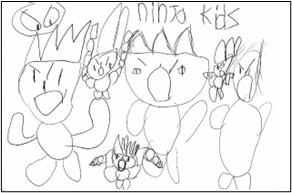
The following vignettes show children’s voices as they solve the two mathematical story problems. In both story problems, children are asked whether each animal or person gets an object. These vignettes also demonstrate giving children the opportunity to engage in sense-making and exercise mathematical agency.
Valuing children’s voices fosters meaningful mathematical communication, empowers them to articulate their mathematical ideas and supports the construction of their own mathematical understanding and problem-solving. These observations provide teachers with useful insights to design and tailor differentiated learning activities that advance children’s mathematical development.
Valuing children’s voices and incorporating children’s perspectives into the early childhood classrooms firstly empower children to express themselves mathematically, taking ownership of their own learning, thereby transforming their mathematics problem-solving experiences positively. Secondly, this illuminates the direction for mathematics curriculum decision-making, as well as shape the effectiveness of education policies, ensuring such policies are relevant and executable in current real-world contexts.
References
Boaler, J. (2000). Identity, Agency, and Knowing in Mathematics Worlds. In J. Boaler (Ed.), Multiple Perspectives on Mathematics Teaching and Learning. Ablex Publishing.
Brigance A. (1992). Brigance K & 1 Screen – Revised. North Billerica, MA: Curriculum Associates, Inc.
Ministry of Education (2023). A curriculum framework for preschool education in Singapore: Educator’s guide for numeracy. Singapore.
Schoenfeld, A. H. (1992). Learning to Think Mathematically: Problem Solving, Metacognition, and Sense Making in Mathematics. In D. Grouws (Ed.), Handbook of Research on Mathematics Teaching and Learning (pp. 334-370). New York: Macmillan.