Young Children’s Voices in Mathematical Problem Solving
Contributed by Dr Ho Siew Yin and Sng Wei Qin Abbie, from NTUC First Campus, for SingTeach Virtual […]
Read More
Over the past two decades of translating Knowledge Building (KB) into practice, one of the most frequently asked questions has been how to integrate KB into existing school structures. A whole school approach represents a bold step toward transforming schools into knowledge-creating communities. Chua Chu Kang Secondary School exemplifies this vision. Classrooms spark curiosity, students are partners in learning and staff are co-learners. The journey has been transformative, shaping a generation that sees learning as communal, dynamic and lifelong. Every learner is seen, every voice matters and every idea can make a difference. Hear from their teachers, students and alumni about the impact of the KB journey.
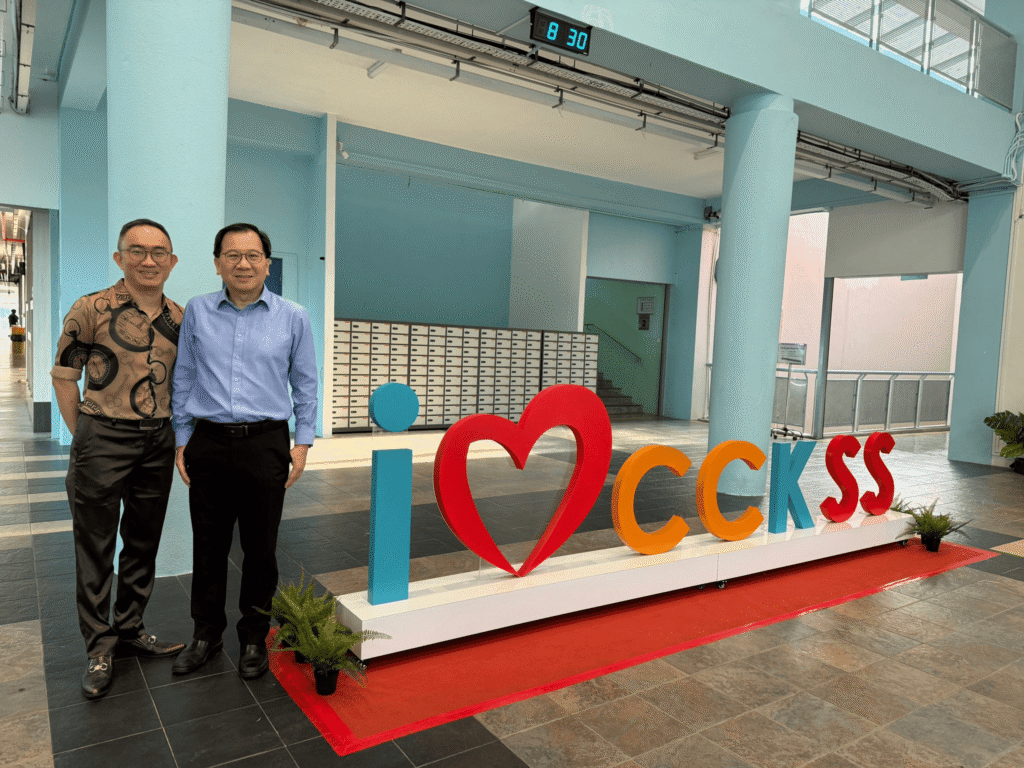
From left to right: Mr Melvin Chan and Mr Timothy Cheng.
By Mr Melvin Chan, Lead Teacher and Knowledge Building Lead, Chua Chu Kang Secondary School (CCKSS)
In the Knowledge Building (KB) community, teachers and students are inventors of educational innovation, not passive adopters. Achieving this requires sustained, trusting partnerships with researchers at NIE. At CCKSS, I have seen a mindset shift over the years: Teachers now design lessons that amplify student voices, foster creativity and inquiry, and embrace collaborative, idea-centric, student-centered practices that are transforming the school systemically.
Our teachers have moved beyond being “the sage on the stage” to become true facilitators of deep thinking – what we now call “guides on the side.” They’ve begun to design learning environments that breathe curiosity and welcome uncertainty, where students are encouraged to ask, not just answer.
Teacher Mdm Mohana, reflected: “I have come to realize the importance of allowing students to take ownership of their learning… My role now is not to provide answers, but to create platforms for them to widen their thinking.”
This spirit of change didn’t stop at individual classrooms. Teachers across different departments began collaborating as knowledge builders themselves – from Music and History to Literature and even Form Teachership.
Music teacher Mr Anthony noted how his Music lessons are no longer limited by his own expertise. “Now, the classroom is a collaborative space where students and I co-construct musical understanding together. It’s made my teaching more dynamic and my students more empowered.”
Just as our teachers evolved with KB, so did our students. CCKSians now build knowledge collaboratively, value each other’s ideas and see every answer as a starting point. In a Literature discussion on Lord of the Flies, one group challenged the view of Jack as a stereotypical villain, framing his moral descent as a struggle rather than a given. Other students built on this interpretation, adding historical, psychological and personal perspectives.
“It became less about the ‘right’ answer,” teacher Ms Klara shared, “and more about a shared exploration of possibilities. The classroom became a living, breathing conversation.”
In History, students became more confident in their own voice. One student shared: “I was worried that there was a correct way to respond. But I’ve realized – we all manage our thinking differently. We can create our own steps to a better response. We just need to trust ourselves.”
Furthermore, student Min Ho talked about how his class used learning analytics in their History inquiry: “We become reflective students… skillful in using technology and thinking scaffolds in moving forward our discussion; measuring and monitoring our learning growth; and making adjustments to our own way of learning patterns.”
The self-efficacy in academic pursuit is visible in their energy and participation. Whether it’s choosing their own inquiry path or giving content-specific feedback to peers using KB scaffolds or using class learning analytics to make changes to their learning, students now own their learning.
The KB culture doesn’t stop at graduation. Isyraf, CCKSS alumni and the participants of the first Knowledge Building Design Studio (KBDS) participants in 2019, now serving National Service, shared: “KB has become a way of life. In my unit, I actively apply KB to team projects and improvement ideas. It’s all about creating a space where everyone feels safe to contribute – and that’s something I first experienced in CCKSS.”
Zachary, who is currently in polytechnic and was a participant of the first KBDS, said: “KB scaffolds help us tackle projects with creativity, empathy and depth. The ‘Consider’ scaffold alone pushes us to explore sensitive issues in ways we couldn’t before.”
And Priya, a current CCKSian, summed it up perfectly: “We’re no longer satisfied with surface learning. We seek feedback – from peers, experts and even parents. Learning has become a social, community-driven act.”
“This spirit of change didn’t stop at individual classrooms. Teachers across different departments began collaborating as knowledge builders themselves – from Music and History to Literature and even Form Teachership.”
– Melvin, on the KB collaboration efforts among teachers
What sets KB research apart from many other educational initiatives is the deeply reciprocal and co-constructive nature of the research-practice partnership.
Since I began my KB journey in 2012 and later cofounded the Knowledge Building Collaborative Network Learning (KBCNL) with NIE’s Dr Teo Chew Lee, I have been privileged to engage in a range of research-practice nexus work, from leading as Principal Investigator for the Tier 2 EduLab KB Project on Curriculum-in-Analytics (CiA), to writing and presenting KB practitioner papers in conferences locally and internationally.
This philosophy of co-agency extends to students as well. Unlike conventional research where students are often positioned as test subjects, KB projects position them as active learners. They are given autonomy, tools to analyse their own learning, and the power to refine or co-design digital platforms like Curriculum Cloud or Promising Ideas. This rare level of trust transforms learning from compliance to co-creation and from passive consumption to ownership of ideas.
At the heart of KB research is the centrality of ideas. Rather than focusing on “right” answers, we track the trajectory of students’ thinking, placing sustained creative inquiry at the core of pedagogy and research.
This aligns with the MOE EdTech Masterplan 2030, empowering students as creators and contributors and supporting teachers as collaborative, data-literate guides. Emerging tools, including AI analytics, enhance rather than replace judgment or agency.
In short, what makes KB research unique is its commitment to Collaborative professionalism, Student epistemic agency, and the growth of Ideas within a community. KB research is not just research on education – it’s research with educators and for the students, where everyone involved is part of a knowledge-creating culture.