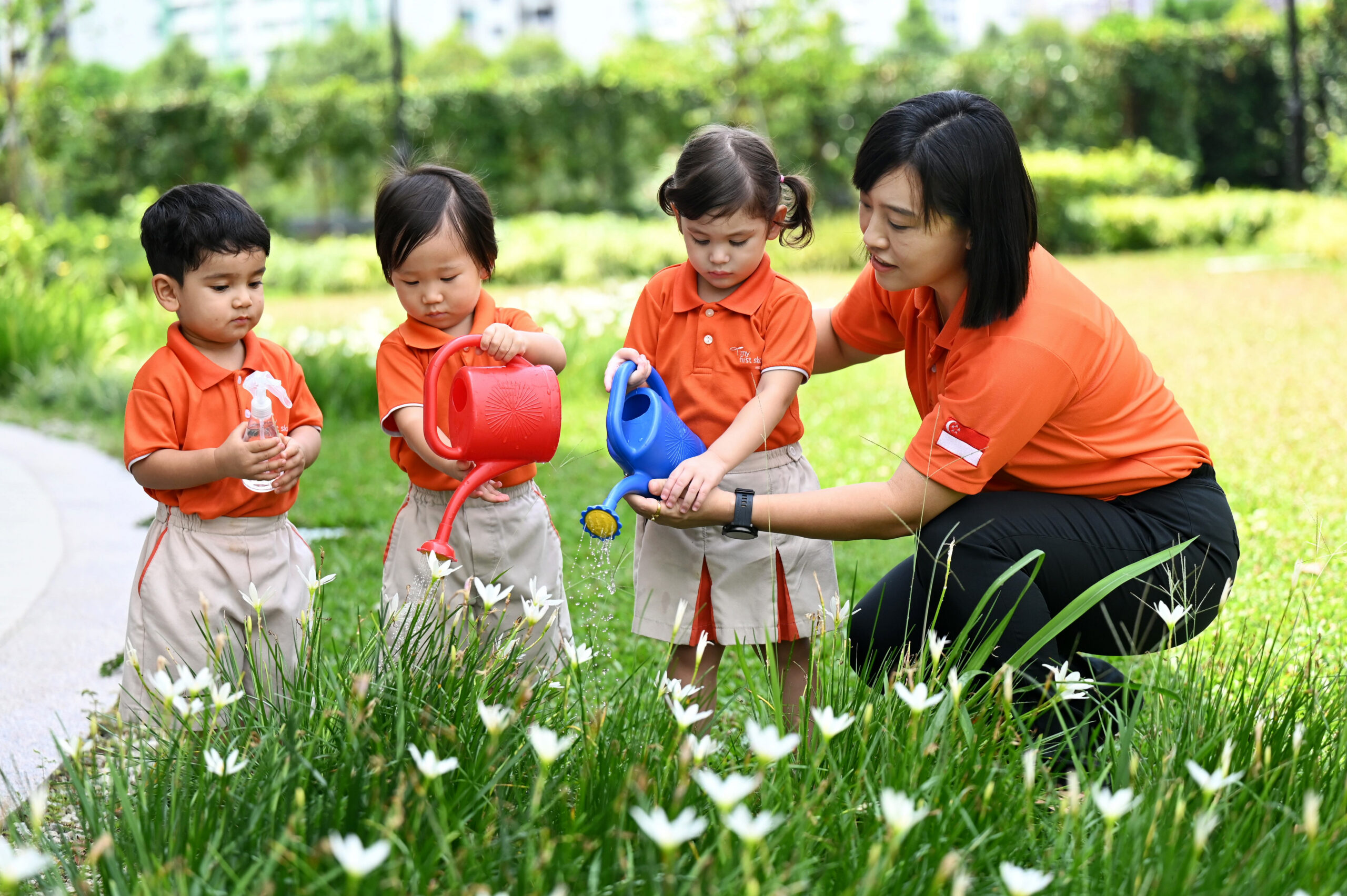
Young Children’s Voices in Mathematical Problem Solving
Contributed by Dr Ho Siew Yin and Sng Wei Qin Abbie, from NTUC First Campus, for SingTeach Virtual […]
Read More
At Pioneer Primary School, teachers are discovering new ways to learn and teach with the help of AI. Partnering with researchers from the National Institute of Education, the school piloted the Knowledge Building Learning Companion for Teachers (KBLCT), a chatbot that supports lesson design and reflection. Mr Shaun Kuat, Head of Department (Information & Communication Technology and Media Resource Library), and school leaders from Pioneer Primary School share how this innovation is shaping teacher learning and collaboration.

From left to right: Mr Shaun Kuat, Mdm Loke Wai Ling and Mdm Wong Wei Yi
By Mr Shaun Kuat, HOD/Information & Communication Technology and Media Resource Library; Mdm Loke Wai Ling, Principal; Mdm Wong Wei Yi, Vice-Principal, Pioneer Primary School
In the age of AI, where information and answers are available at the click of a button, students must shift from being passive recipients to active creators of knowledge. To thrive, they need to think critically, make meaningful connections, and generate new ideas and solutions. Simply using tools like ChatGPT is not enough – educators now face the important challenge of thoughtfully integrating AI into teaching and learning.
Early adopters of Knowledge Building (KB) in local schools have seen a shift in classroom dynamics, with student voice and agency taking center stage, and the teacher’s role refocused. The KB Learning Companion for Teachers (KBLCT) supports lesson planning and implementation, and through collaboration with NIE researchers, teachers at Pioneer Primary School have identified natural pathways for AI integration. This partnership allows educators to personalize KB experiences to suit students’ needs, enhancing both teaching and learning.
“To thrive, they [students] need to think critically, make meaningful connections, and generate new ideas and solutions.”
– Shaun, Wai Ling and Wei Yi, on how students can be active creators of knowledge
The implementation of KB at Pioneer Primary School has had a positive impact, evident in the transformative conversations among our teachers. Initially seen as just another framework, KB took on new meaning after teachers engaged with the KBLCT, shifting their pedagogical beliefs. They began to view KB as a lens connecting approaches across subjects, sparking excitement as they questioned assumptions, built on each other’s ideas and deepened their collective understanding of effective pedagogy.
Significantly, teachers’ discussions about lesson design showed greater intentionality in amplifying student voice – a sign of professional growth and engagement. As KB principles were integrated into classrooms, teachers connected curriculum and pedagogy more coherently.
Over time, this fostered a KB culture in the school – one marked by intrinsic motivation, empowerment, collaborative learning and positive dispositions toward inquiry. Ongoing reflection and dialogue enriched this experience, helping teachers continually improve ideas and advance knowledge.
Participating in KB research, particularly in introducing KBLCT to teachers, has transformed our understanding of effective middle leadership and professional development. The experience revealed the limits of traditional one-size-fits-all professional development and highlighted the need for responsive, context-sensitive approaches.
Rather than relying on prescriptive workshops, we used KBLCT to create spaces where teachers could make sense of KB practices and apply them within their subjects and classrooms. A phased approach allowed us to develop “trainers of trainers,” leveraging distributed expertise and fostering peer-to-peer, community learning aligned with KB principles.
Most importantly, the research taught us that intellectual humility is a leadership strength. Embracing not knowing everything and inviting teachers into a collective sense-making journey proved more powerful than positioning ourselves as sole experts. KB research has fostered genuine collaborative inquiry, creating conditions where leaders and teachers engage as co-learners and advance collective understanding.
Sustaining KB requires learning and relearning as it becomes integrated into practice. Common misconceptions include:
These challenges highlight that embedding KB sustainably requires seeing it not just as teaching strategies but as a mindset and culture that permeates all learning contexts. Ongoing reflection and nuanced understanding help integrate KB principles into diverse classroom scenarios.
Building on the success of introducing the KBLCT to teachers, the next step is exploring student-focused AI as a learning companion to foster curiosity, metacognition and collaborative learning, complementing teachers’ KB lesson designs.
Looking ahead, our school aims to make KB an integrative, foundational approach to everyday learning that authentically develops 21st century competencies. Central to this vision is cultivating a robust culture of collaborative KB, where individual achievements and collective effort are equally valued.
We also aim to shift focus from learning as a product to learning as a process, helping teachers and students appreciate the intellectual work of questioning, theorizing, evidence gathering and improving ideas. Most importantly, we envision a culture where every member of the learning community is recognized as a capable contributor with unique insights. Success will be measured not by isolated KB lessons, but by how deeply the KB culture and understanding are embodied across all school learning.