 By Dr Tricia Seow, Senior Lecturer, NIE
Young Children’s Voices in Mathematical Problem Solving
Contributed by Dr Ho Siew Yin and Sng Wei Qin Abbie, from NTUC First Campus, for SingTeach Virtual […]
Read More
In its journey with Knowledge Building (KB), Chua Chu Kang Secondary School (CCKSS) has come to see it as more than a pedagogical method – it is a mindset and cultural shift. Participation in KB research and projects has profoundly influenced how CCKSS educators view teaching and learning and has reshaped their understanding of professional development in powerful, lasting ways.
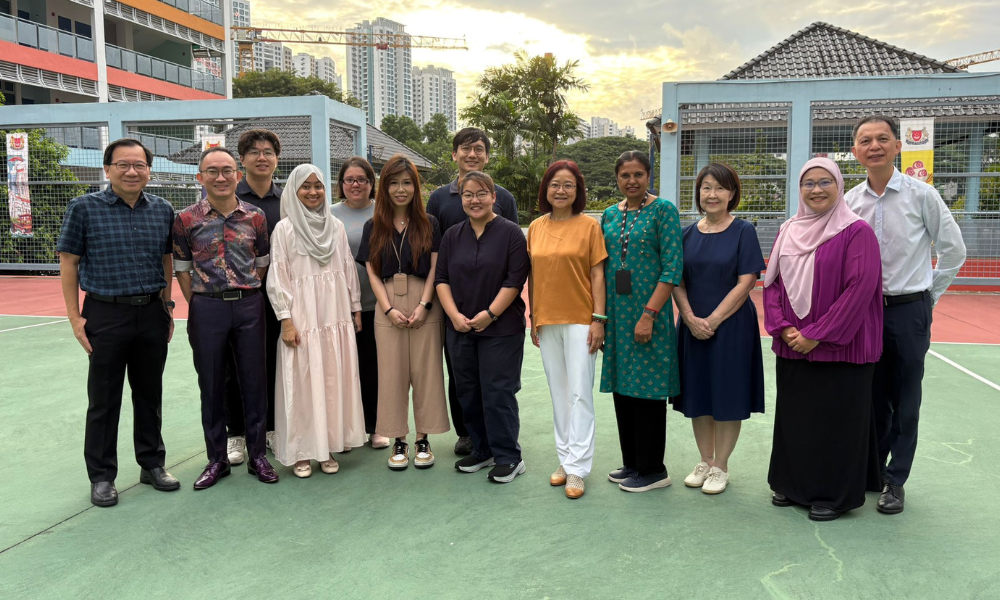
Knowledge Building practitioners from Chua Chu Kang Secondary School
By Mr Melvin Chan, Lead Teacher and Knowledge Building Lead, Chua Chu Kang Secondary School
“I now see my role as that of a facilitator and co-learner – someone who nurtures a climate where students’ curiosity and interpretations drive learning,” shared teacher Ms Klara. This shift is perhaps the most fundamental change many teachers have experienced. Classrooms are becoming Knowledge Building (KB) communities, where student voices drive inquiry and teachers adopt more collaborative, less authoritative roles.
In Literature, students don’t just interpret texts – they challenge assumptions, reimagine narratives, and build deeper meanings together. As Klara describes the focus is now on how ideas evolve through collective inquiry: “We actively improve on each other’s ideas, think about what we agree with and stretch each other’s thinking.”
In Music, Mr Anthony reflects on how KB has turned performance and composition into shared acts of listening and empathy. Students learn to listen to one another, building skills and community through inquiry.
For Mrs Vena Foo, the shift means recognizing that “all learning is social and all learning is emotional.” Feedback-rich cultures and thoughtful use of technology have transformed her classroom into a lively space of shared meaning-making.
We remain the subject experts but no longer the sole experts. We focus less on delivering content and more about designing conditions for inquiry, dialogue and metacognition to happen. And in doing so, we, too, grow alongside our students.
We remain content specialists and pedagogical designers – but we are now also co-learners, idea nurturers and culture builders. The value of a lesson lies not in how quickly students find the right answer, but in how deeply they engage in the KB process. We now ask: How can we support students to improve their ideas over time, build shared understanding and navigate ambiguity together?
For those in teacher leadership, the KB journey has reshaped how we approach adult learning and professional growth. My role as KB lead has led to the creation of a CAN PD culture, where:
Professional development is no longer passive or top-down. It’s now about co-design, co-inquiry and co-innovation. This spirit led to three key initiatives:
Being part of the research team has taught us the importance of relevance and responsiveness in practice. The partnership reinforces that innovation must address real needs and be driven by reflection, data and shared insights within the KB community.
It has given us the space to embed differentiated instruction principles into our KB framework, experiment with AI tools like the KBLCT Chatbot for just-in-time planning and feedback and use learning analytics to measure not only student performance but also the quality of idea improvement and discourse patterns.
More than a research project, KB has become a professional identity – challenging us to think deeply, act collectively and aspire boldly. Ultimately, teaching is not just about what we deliver – but what we help communities discover, build and become.
As we reflect on the journey of KB in Singapore so far, and begin to imagine what lies ahead, one thing is clear: We are not simply equipping learners to absorb knowledge – we are nurturing communities that create knowledge.
Mr Timothy Cheng, Principal of CCKSS, says: “My hope (they are the hopes of my colleagues too) for the next phase of KB is rooted in this conviction – that schools will evolve into knowledge-creating organizations where every learner, educator and stakeholder plays an active role in shaping ideas that matter.”