Young Children’s Voices in Mathematical Problem Solving
Contributed by Dr Ho Siew Yin and Sng Wei Qin Abbie, from NTUC First Campus, for SingTeach Virtual […]
Read More
In every classroom, students bring a diverse range of learning abilities, experiences and needs. How can educators ensure that each student receives the support they need to thrive? Differentiated Instruction (DI) offers a solution. Assistant Professor Delia Kan Dang Dang, from the National Institute Education’s Psychology and Child & Human Development Department, shares insights on DI, its implementation in the United States, and how Singapore’s special education (SPED) classrooms have adopted this approach. She also highlights key takeaways that mainstream schools in Singapore can consider to better cater to the diverse learning needs of students.

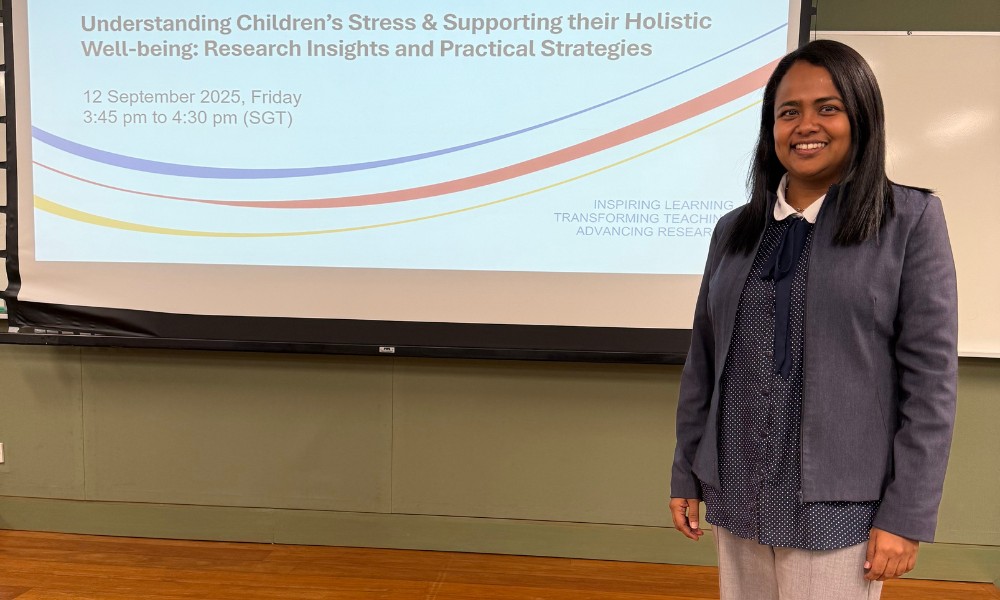
Assistant Professor Delia Kan, Psychology and Child & Human Development (PCHD) Academic Department, National Institute of Education
Differentiated Instruction (DI) is a framework designed to support teachers in addressing the diverse needs of students within a classroom. While DI shares similarities with other educational frameworks like Universal Design for Learning (UDL), it differs in its approach. Both UDL and DI attempts to maximize students’ learning through offering multiple ways to access content, demonstrate knowledge and engage students – the key difference is in when and how the changes are made to address the students’ needs.
“DI involves tailoring instruction based on student needs identified in their class through formative assessments, making modifications as needed. In contrast, UDL emphasizes designing lessons to be accessible to most/all students from the outset, recognizing and planning for classroom diversity in advance,” Delia explains.
DI operates within the broader Multi-Tiered System of Support (MTSS) framework at Tier 1, where teachers incorporate these strategies in a typical classroom environment. By incorporating DI, teachers create learning environments where students can access content in multiple ways, demonstrate their understanding through different means and remain engaged in their learning journey.
A well-structured classroom that enacts DI relies on thoughtful physical organization and manpower support. Designated learning spaces for small-group instruction, independent work and peer collaboration help ensure that students receive the targeted support they need.
In an inclusive elementary classroom in the United States, for instance, lessons typically begin with whole-group instruction, where teachers introduce key concepts to all students. This ensures that everyone receives a common foundation before transitioning into smaller, ability-based groups. Pre-assessments determine student readiness, allowing educators to form ability-based groups.
Once students transition into differentiated learning experiences, the teacher provides targeted instruction to learners struggling academically in a small-group setting, offering additional targeted support (e.g., repetition, errorless prompting) and scaffolding to help them grasp the material. Meanwhile, other students engage in independent or peer activities in other parts of the classroom, with classroom assistants available to guide them when needed. Classroom support staff play a crucial role, assisting with behaviour management and providing additional guidance during academic lessons. This ensures that all learners can receive guidance even while the main classroom teacher works with students in the small group.
“By implementing these differentiated strategies, teachers create an inclusive and effective learning environment that accommodates diverse student needs while promoting engagement and independence,” Delia says.
“By implementing these differentiated strategies, teachers create an inclusive and effective learning environment that accommodates diverse student needs while promoting engagement and independence.”
– Delia, on the benefits of implementing the differentiated strategies
In Singapore’s SPED classrooms, DI is a familiar approach, ensuring that teaching strategies align with the diverse abilities and learning needs of students.
Many SPED classrooms operate within a co-teaching model, where at least two teachers work together to provide instruction. This model allows for small-group learning, where one teacher leads a focused session with students requiring intensive support, while the other teacher facilitates independent or peer-assisted activities in structured learning spaces. These setups can include spaces dedicated to sensory activities, communication skill development or functional academics.
A lesson incorporating DI practices in a SPED classroom may start with whole-class introduction, using multimodal teaching strategies like visual supports, storytelling and hands-on demonstrations. Students then move into smaller groups, ensuring that learning activities align with their individual needs. Some classes may begin in these smaller groups from the outset, where a teacher each take a small group for instruction, especially if students in the class struggle with joint attention in a larger group setting.
Aligning with the DI framework, teachers then adapt content, processes and outcomes to suit the varied needs of students. For example, in a literacy lesson, students with emergent literacy skills might engage in tactile letter formation activities, while those with more advanced skills practice sentence construction with teacher guidance.
While DI is a familiar term to teachers in SPED classrooms, mainstream schools in Singapore can learn from these strategies to better support diverse learners in their class.
A classroom enacting DI can be enhanced by flexible furniture arrangements to support different types of instruction. Teachers should create quiet areas for independent work, collaborative spaces for group activities and designated areas for teacher-guided learning.
Mainstream classrooms may not require a full co-teaching model, but having classroom support staff – such as teaching assistants – can enhance the effectiveness of DI. In SPED classrooms, both staff in the classroom should have similar levels of instructional expertise to provide both academic and behavioural support. In mainstream schools, these support staff could focus on managing classroom dynamics while teachers work with smaller groups who need more targeted instructional support.
Establishing clear routines, setting expectations for independent learning and fostering a growth mindset help students take ownership of their learning. For example, routines that allow students to receive or find support –when teachers are busy with other students and cannot support them immediately as they are engaged with the other small groups – are important. Schools can also provide professional development for teachers to equip them with strategies for implementing DI more effectively.
“By integrating these strategies, mainstream schools can create more inclusive learning environments, ensuring that every student is able to receive the level of support they need and has the opportunity to succeed,” Delia shares.