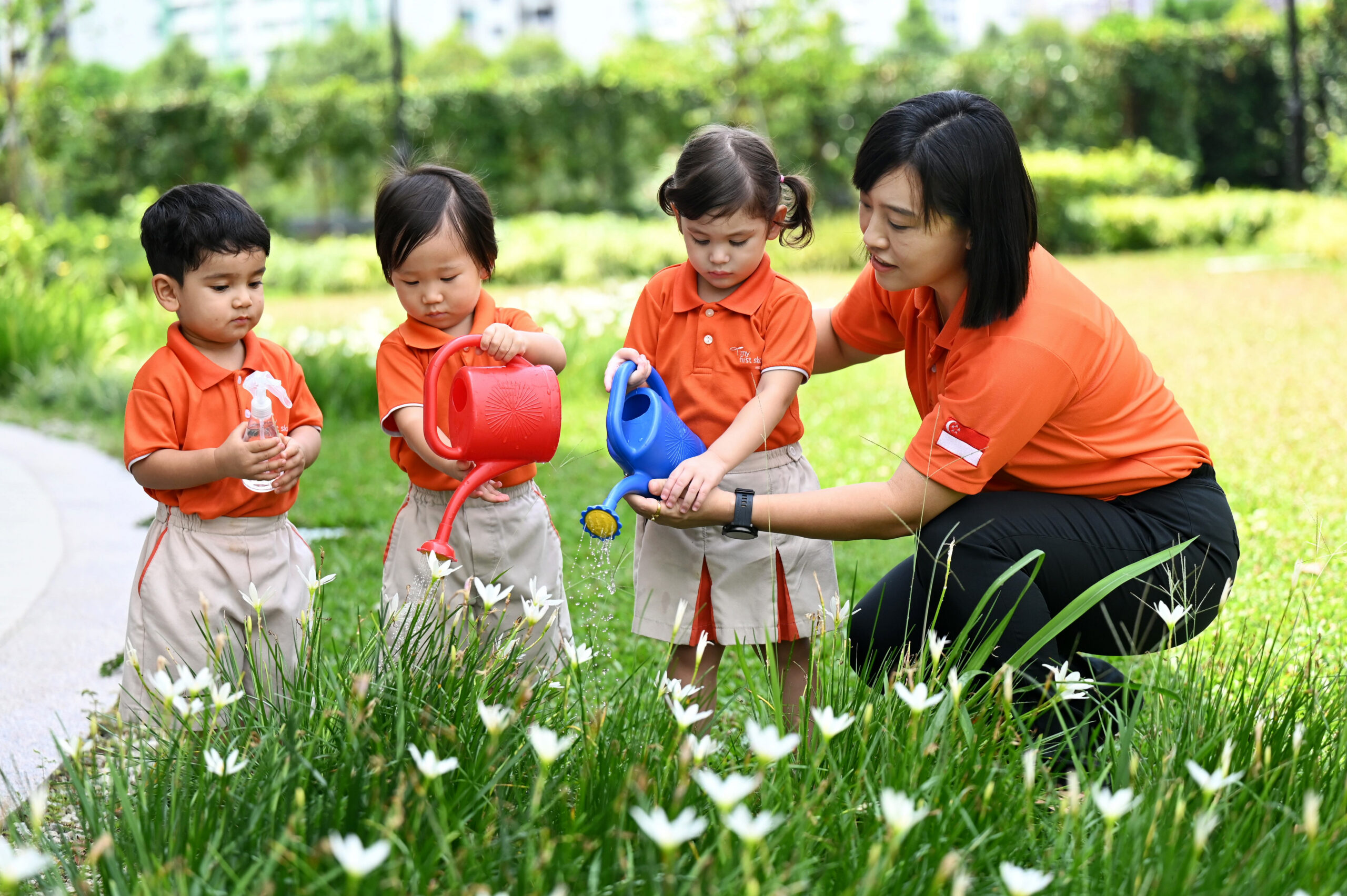
Young Children’s Voices in Mathematical Problem Solving
Contributed by Dr Ho Siew Yin and Sng Wei Qin Abbie, from NTUC First Campus, for SingTeach Virtual […]
Read More
At Unity Secondary School, lessons are intentionally designed to keep students cognitively engaged at every stage of their learning experience. Recognizing that learners have diverse needs, the school has invested in building teacher capacity to effectively enact Differentiated Instruction (DI) in the classroom. In this article, we speak with three teachers from the school who share how DI principles guide their lesson design, from tailoring learning activities and scaffolding tasks to embedding formative assessment. They highlight how thoughtful planning and reflective teaching practices can make learning more inclusive, engaging and meaningful for every student.

From left to right: Liang Yen Shan, Jacqueline Tan and Sumitha
Ms Jacqueline Tan, Lead Teacher for Biology at Unity Secondary, highlights the critical role of thoughtful learning design in fostering student engagement. “Students are more likely to be cognitively engaged when learning experiences are intentionally structured to meet their learning needs,” she shares.
At Unity Secondary, learning design follows the three phases of the Active Learning Process: Activating Learning (surface learning), Promoting Thinking and Discussion (deep learning) and Demonstrating Learning (transfer of learning). Each phase plays a vital role in supporting students’ learning experience.
“Our teachers are guided by the school’s instructional model, which clearly defines the roles of both teachers and students at each phase of the active learning process,” she explains. “This fosters a shared understanding of what meaningful engagement looks like for all participants in the learning journey.”
Establishing goal clarity is a crucial starting point in the design process. It enables teachers to craft success criteria that clearly articulate what students should be doing to be considered competent in meeting the learning outcomes.
The school is also strategic in selecting the necessary pedagogical approaches that will align with the intended learning outcomes.
“To shape learning experiences that meet students’ diverse learning needs, our teaching approach is guided by the key principles of Differentiated Instruction (DI): (1) Quality Curriculum – for goal clarity, engagement and understanding; (2) Formative Assessment – the persistent use of pre- and ongoing assessment to know where students are in relation to the learning targets; and (3) Instructional Options – addressing students’ varied readiness levels,” she explains.
At Unity Secondary, teachers design lessons with the goal of deepening students’ understanding of subject content while integrating real-world applications to make learning more meaningful. Jacqueline shares her experience in designing an inquiry-based Biology lesson.
As part of a lesson on carbon sinks, students worked in groups to investigate how much carbon dioxide a tree can absorb. One of the key learning activities involved using varied methods of collecting data, such as the girth and height of trees around the school, and then comparing findings across groups to identify patterns and trends in carbon absorption.
“To make the data more meaningful, the activity was connected to real-world issues,” she shares. “Students visited the SP Group website to estimate how many trees would be needed to offset their carbon footprint. This led to a discussion on Singapore’s One Million Trees Movement – a nationwide effort to plant a million more trees by 2030.”
“One of the key goals in designing the lesson was to encourage students to think critically about their environmental impact and reflect on how individual actions contribute to global sustainability efforts,” she adds. “It also challenged students to consider that what may seem like a massive national initiative might, in reality, not significantly reduce Singapore’s overall carbon emissions – prompting deeper thinking about the scale of change needed.”
“Students should perceive their group activities as being tailored to support their learning, not as a sign they’re struggling. This approach encourages collaboration and reduces negative comparisons or self-doubt.”
– Sumitha, on the importance of intentional groupings
Ms Sumitha, Level Head Science, comments that Subject-Based Banding (SBB) starts from Primary 5 and 6. SBB allows students to take subjects at standard or foundation levels, based on their strengths and aptitudes.
“Students are familiar with SBB during their primary school years and when they enter secondary school, full SBB is already a familiar concept to them,” she notes. “Thus, they have a more positive view towards scaffolded assignments and learning activities, and are more open to try them.”
Ms Liang Yen Shan, Acting HOD Science, agrees and states that this eases teachers’ role in enacting DI. She shares an example of how tiered assignments and learning activities have been applied in her classroom.
“Last year, there was a Science lesson where students mixed chemicals and recorded their observations,” she shares. “To make the experience more engaging and student-centred, I moved the lesson out of the lab and into the classroom. We used micro volumes of chemicals to safely facilitate the activity in this informal setting.”
The students were grouped based on their readiness levels. Those in the higher readiness group were given open-ended questions. They were allowed to experiment by mixing the different chemicals together and writing their own observations. In contrast, those in the lower readiness group were assigned two specific chemicals to mix, with helping words provided for guidance.
“The students in the lower readiness group found the scaffolding to be useful as they felt supported in their learning experience,” she remarks.
During the school’s professional development on DI, staff were briefed on the importance of intentional groupings. One key consideration is the use of neutral, engaging group names to avoid stigmatizing students based on their readiness levels.
“Students should perceive their group activities as being tailored to support their learning, not as a sign they’re struggling,” Sumitha explains. “This approach encourages collaboration and reduces negative comparisons or self-doubt.”
The school has invested much of its effort in seamlessly integrating formative assessment into the learning process. Jacqueline highlights that the SLS platform helps make students’ thinking visible, enabling teachers to provide timely, targeted and actionable feedback.
Yen Shan shares how at the end of a Chemistry lesson on acid properties, teachers consolidated students’ observations and explanations submitted on the (Student Learning Space) SLS platform so that they can address any misconceptions and reinforce key concepts in a timely manner.
“Teachers provided clear and specific actions that the students can take to refine their understanding,” she shares. “Each student was then tasked to create a graphic organizer which served as an exit ticket that demonstrate their understanding of the key concepts.”
SLS also plays an important role in encouraging student reflection and self-assessment.
Jacqueline shares a Biology lesson where students dissected a sheep’s heart. They began by setting personal learning goals – such as overcoming their fear of handling heart tissue – then worked in groups to carry out the dissection and created videos explaining the blood flow through the heart using the specimen. The videos were uploaded to the SLS platform for peer assessment and review. It was followed by self-evaluation, in which students reflect on how well they have worked interdependently as a team and supported their reflections with evidence.
“I was heartened to see many students articulating their learning and making meaningful connections to their personal growth,” she remarks.
“Our professional development strategy is centred on deepening and enhancing teachers’ teaching and learning practices,” Jacqueline explains. “It’s about strengthening teachers’ competencies to create more effective learning experiences for all students.”
Professional development at Unity Secondary is anchored in the PLC@Unity Process and guided by the 5Cs approach – Calibrate, Curate, Create, Collaborate and Connect. Each year, teachers engage in a rigorous and reflective design process, where they adopt, or adapt, existing SLS Active Learning lessons and integrate new strategies, such as DI, that align with their department’s baseline pedagogical approach.
“Teachers seek peer feedback to refine their designs and, during lesson enactment, conduct classroom observations to gather evidence of student learning,” she adds. Insights garnered from student work inform ongoing review and refinement, with teachers encouraged to share successful practices beyond the school.
“Collaboration, sharing and continuous learning are at the heart of refining our teaching practices,” she says. “We’re in this for the long haul – committed to deliberate and purposeful professional development for every teacher, no matter where they are in their professional journey.”
“Collaboration, sharing and continuous learning are at the heart of refining our teaching practices. We’re in this for the long haul – committed to deliberate and purposeful professional development for every teacher, no matter where they are in their professional journey.”
– Jacqueline explains more about the school’s professional development strategy